By Claire Whitaker
Updated November 2026
Looking for diy solar panels for shed use? Most sheds need only enough power for lights, fans, a charger or a small tool, so the right kit depends on your load, your battery and how much wiring you are willing to do. The picks below are selected from product listings, brand reputation and owner feedback patterns. They are chosen for kit completeness, battery capacity, charge controller type and how easily each setup suits a small outbuilding.
Our top picks at a glance
- 1
 TOP CHOICEBest overallECO-WORTHY 200 Watts 12 Volt/24 Volt Solar Panel Kit with 30A PWM Charge ControllerView on Amazon
- 2
 TOP CHOICEBest for upgrade pathsRenogy 400 Watt Premium Solar Kit with 40A MPPT Charge ControllerView on Amazon
- 3
 TOP CHOICEBest for whole-building backupECO-WORTHY 10kW Whole House System with 16kWh StorageView on Amazon
- 4
 Best for a simple starter setupECO-WORTHY 200 Watt 12 Volt Starter Kit with Battery and InverterView on Amazon
- 5
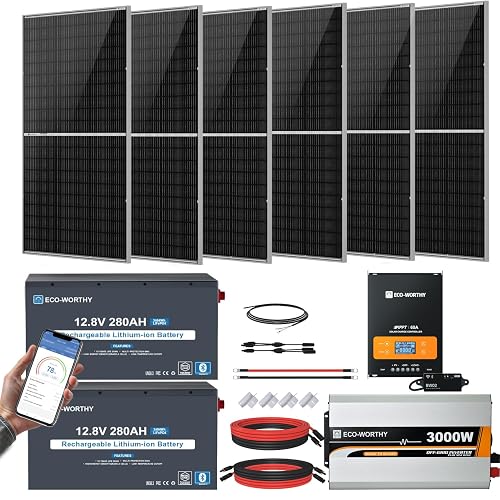 Best for mid-size loadsECO-WORTHY 1200W 24V Solar System with 4.68kWh Lithium BatteryView on Amazon
- 6
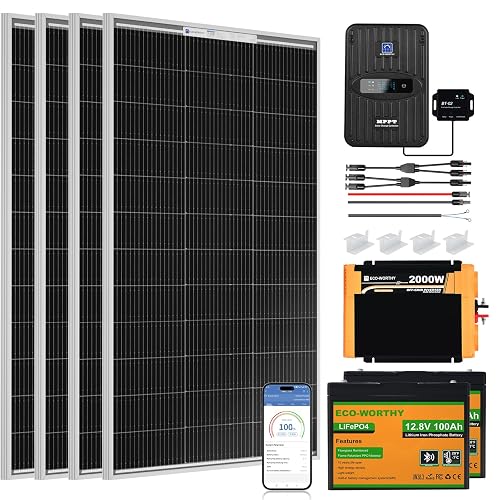 Best for Bluetooth monitoringECO-WORTHY 1.6kWh Complete Solar Panel Kit 400W 12V with BluetoothView on Amazon
Our Top Picks
| Product | Best for | Key feature |
|---|---|---|
| ECO-WORTHY 200W 12V/24V Kit | Overall shed use | PWM charge controller included |
| Renogy 400W Premium Kit | Expandable setups | 40A MPPT controller, Bluetooth |
| ECO-WORTHY 10kW Whole House Kit | Whole-building backup | 16kWh storage, split-phase output |
| ECO-WORTHY 200W Starter Kit | Simple starter setup | Battery and inverter included |
| ECO-WORTHY 1200W 24V System | Mid-size loads | 4.68kWh lithium battery |
| ECO-WORTHY 1.6kWh Complete Kit | Monitoring and control | Bluetooth module, 40A MPPT |
ECO-WORTHY 200 Watts 12 Volt/24 Volt Solar Panel Kit with 30A PWM Charge Controller
ECO-WORTHY 200 Watts 12 Volt/24 Volt Solar Panel Kit with High Efficiency Monocrystalline Solar Panel and 30A PWM Charge Controller for RV, Camper, Vehicle, Caravan and Other Off Grid Applications
Best for: Overall shed use with a modest load.
This kit suits someone who wants a single, straightforward setup for lights, fans and phone charging in a shed or small outbuilding.
Pros
- Supports both 12V and 24V system voltages.
- Includes a 30A PWM charge controller.
Cons
- PWM controllers are less efficient than MPPT in cold or low-light conditions.
Renogy 400 Watt Premium Solar Kit with 40A MPPT Charge Controller
4x100W monocrystalline panels. 40A MPPT charge controller. Includes Bluetooth module, Z-brackets, cables, adaptor kit. Renogy 400Watt Premium Solar Kit with 40A MPPT Charge Controller
Best for: Expandable setups that may grow over time.
Owners who plan to add panels or batteries later often look at this kit because its MPPT controller handles more input.
Pros
- Four 100W panels with a 40A MPPT controller.
- Bluetooth module for monitoring.
Cons
- Requires a separate battery and inverter.
ECO-WORTHY 10kW Whole House System with 16kWh Storage
Whole House System:10KW 120V/240V Split Phase Solar Inverter| 48V 314Ah 16kWh High Capacity Energy Storage| 2950W Solar Panel ECO WORTHY 10000W Output Complete Off-Grid Solar Panel Kit for Home
Best for: Whole-building backup on a larger property.
This system is far larger than most sheds need, but it may suit someone powering a shed and a home from one off-grid array.
Pros
- Split-phase 120V/240V output.
- 16kWh lithium storage capacity.
Cons
- Oversized and complex for a simple shed project.
ECO-WORTHY 200 Watt 12 Volt Starter Kit with Battery and Inverter
with Battery and Inverter: 2*100W Solar Panel + 30A Charge Controller + 100Ah Lithium Battery + 1100W Premium Solar Inverter ECO-WORTHY 200 Watt 12V Complete Solar Panel Starter Kit for RV Off Grid
Best for: A simple starter setup that includes everything.
Beginners who want a battery and inverter in the box, rather than sourcing parts separately, often start here.
Pros
- Includes a 100Ah lithium battery and 1100W inverter.
- Two 100W panels with a 30A controller.
Cons
- Limited headroom for larger tools.
ECO-WORTHY 1200W 24V Solar System with 4.68kWh Lithium Battery
6pcs 195W Solar Panels+2Pcs 12.8V 280Ah Lithium Battery+60A MPPT Charge Controller+3000W Pure Sine Wave Inverter [Ultra] ECO-WORTHY 1200W 24V 4.68KWH Lithium Battery Solar System Off Grid
Best for: Mid-size loads such as a small workshop.
This kit fits a shed running power tools intermittently, a small fridge or a workbench setup.
Pros
- Six 195W panels with a 60A MPPT controller.
- 3000W pure sine wave inverter.
Cons
- Heavier installation than a basic kit.
ECO-WORTHY 1.6kWh Complete Solar Panel Kit 400W 12V with Bluetooth
ECO-WORTHY4 * 100W Solar Panel + 40A MPPT Controller + 2 * 12V 100Ah Lithium Battery + Upgraded 2000W Power Inverter + Bluetooth Module 1.6KWH Complete Solar Panel Kit 400W 12V for RV Off Grid
Best for: Monitoring and control of charge levels.
Owners who like watching battery state and output from a phone often pick this kit for its Bluetooth module.
Pros
- Bluetooth module for real-time data.
- Two 12V 100Ah lithium batteries.
Cons
- Setup involves more wiring decisions than a plug-and-go kit.
Buying Guide
Know Your Shed’s Power Needs
Before comparing kits, add up the devices you plan to run, such as LED lights, a ceiling fan, a phone charger or a small power tool. A kit sized for a few lights and a charger will be far less expensive than a system built to run a workshop with larger motors.
Think about when you will use power, too. If you only need light in the evening, a battery that holds enough charge overnight matters more than raw panel output.
Battery Capacity and Chemistry
Battery capacity determines how long your shed can run after sunset or on cloudy days. Lithium batteries generally offer more usable capacity, longer life and lighter weight than older lead-acid designs, though they cost more up front.
Match the battery voltage to your inverter and charge controller. Mixing mismatched components is one of the most common causes of problems in DIY setups.
Charge Controller Type
PWM charge controllers are simpler and less costly, but they work best when panel voltage closely matches battery voltage. MPPT controllers handle a wider range of panel voltages and can squeeze more usable power from the same panels, especially in cooler or less-than-ideal sunlight.
If your panels are wired in a higher-voltage series arrangement, an MPPT controller is usually the better choice.
Inverter Needs
If you need standard household outlets in the shed, you will need an inverter to convert battery power to AC. Check the continuous wattage rating and make sure it exceeds the combined draw of the devices you plan to run at the same time.
Kits that include no inverter are fine for DC-only loads such as 12-volt lights and USB charging, which can keep costs lower.
Installation and Mounting Options
Consider the roof or ground space available and how the panels will be mounted. Included mounting brackets, cables and connectors can save time, but confirm they fit your roof pitch and the wire gauge suits your run from the panels to the shed.
FAQ
Can a DIY solar kit run everything in my shed?
Most kits are designed for lighting, fans, chargers and small tools rather than heavy equipment. Calculate your total daily energy use and choose a system with enough battery storage to cover it. Larger systems can handle bigger loads but cost more.
Do I need an electrician to install a shed solar system?
Low-voltage DC setups are often manageable for DIY installers who follow the manufacturer instructions carefully. If you plan to connect to your home electrical panel or run AC wiring, check local codes and consider hiring a licensed electrician.
How many panels do I need for a small shed?
The number of panels depends on your daily energy needs and how much sunlight your location gets. A small lighting and charging load usually needs far less than a full workshop. Starting with a kit that matches your estimated usage is the simplest approach.
Is a lithium battery worth the extra cost?
Lithium batteries typically last longer, weigh less and deliver more usable capacity than lead-acid options. For a shed that will be used regularly over many years, the longer service life often makes them a sound investment.
Can I add more panels or batteries later?
Many kits are designed to expand, but you must confirm that your charge controller and inverter can handle the additional capacity. Check voltage and current limits before adding components so you do not overload your equipment.
Conclusion
For a basic shed with lights and a charger, a smaller 12-volt starter kit with a modest battery is usually the most practical choice. If you plan to run more equipment or want a path toward a larger off-grid setup, a higher-capacity kit with an MPPT controller and inverter will serve you better.
Related reading
- DIY Solar Power for Shed: Steps, Sizing and Parts for Beginners
- DIY Solar Panels for RV: A Step-by-Step Guide for Beginners
- DIY Solar Heater for Shed: A Step-by-Step Guide for Beginners
- DIY Balcony Solar Panels: A Step-by-Step Guide for Beginners
- 7 Best DIY Small Solar Panel Mounts for Small Projects (2026)
- Small Solar Panel for Shed: 7 Best Picks for Every Need (2026)
About Claire Whitaker
Claire Whitaker is part of our editorial team and reviews and edits our small-scale solar guides, checking product details against manufacturer specifications and owner feedback.