By Claire Whitaker
Updated November 2026
Finding the best RV solar panel kit with battery and inverter comes down to matching the system to how you camp. Weekend trips with a fridge and lights need something different from full-time boondocking with air conditioning or a laptop workstation. The kits below were compared on the criteria that matter most in practice: total panel wattage, battery capacity and chemistry, inverter output and surge rating, the charge controller type, whether the parts are sold as a coordinated set, and the patterns owners tend to report after installation.
Our top picks at a glance
- 1
 TOP CHOICEBest overall1280WH Complete Off-Grid Solar Panel Kit with 1000W Pure Sine Wave InverterView on Amazon
- 2
 TOP CHOICEBest for high-output needs4PCS N-Type Bifacial 195W Solar Panel+12.8V 314Ah Lithium Battery+60A MPPT KitView on Amazon
- 3
 TOP CHOICEBest for simple starter setupsECO-WORTHY 200 Watt 12V Complete Solar Panel Starter KitView on Amazon
- 4
 Best budget pickECO-WORTHY 200 Watts 12 Volt/24 Volt Solar Panel KitView on Amazon
- 5
 Best for whole-home backupWhole House System 10KW Split Phase Solar Inverter KitView on Amazon
- 6
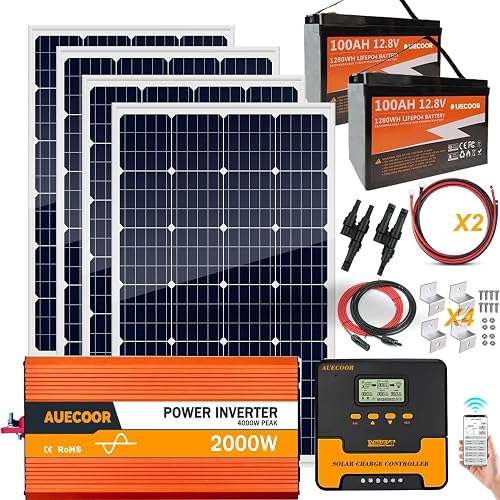 Best for mid-size RV rigs92KWH Complete Solar Panel Kit for RV Off Grid Solar SystemView on Amazon
- 7
 Best for larger battery banks4PCS 195W Solar Panels, 3000W UPS Inverter Charger, 2PCS 12.8V 280AH Lithium Batteries KitView on Amazon
Our Top Picks
Quick Comparison
| Product | Best for | Key feature |
|---|---|---|
| 1280WH Complete Off-Grid Solar Panel Kit | Balanced all-around RV use | 1000W pure sine wave inverter with 100Ah battery |
| 4PCS N-Type Bifacial 195W Solar Panel Kit | High-demand appliances | 2000W pure sine wave inverter and 60A MPPT controller |
| ECO-WORTHY 200 Watt 12V Starter Kit | Small setups and weekend trips | 200W panels with 50Ah lithium battery |
| ECO-WORTHY 200 Watts 12/24V Kit | Budget-conscious builds | 30A PWM controller with 12V or 24V compatibility |
| Whole House System 10KW Split Phase Kit | Large loads and home-style backup | 48V 16kWh storage with split-phase output |
| 1.92KWH Complete Solar Panel Kit for RV | Trailers and campers | Two 100Ah batteries and four 120W panels |
| 4PCS 195W Solar Panels with 3000W UPS Kit | Larger battery banks | Two 280Ah lithium batteries and Bluetooth MPPT controller |
1280WH Complete Off-Grid Solar Panel Kit with 1000W Pure Sine Wave Inverter
1280WH Complete Off-Grid Solar Panel Kit with 1000W Pure Sine Wave Inverter, 20A MPPT Controller & 100Ah 12.8V Battery, 2×120W Monocrystalline Solar Panels for RV Boat Cabin Shed Home Backup
Best for: Balanced all-around RV use
This kit suits campers who want a single, coordinated system that covers lighting, phone and laptop charging, a small fridge and the occasional microwave. The listing describes it for RVs, boats, cabins and sheds, so it works for mixed-use setups.
Key specs
- Total stated capacity: 1280Wh
- Inverter: 1000W pure sine wave
- Battery: 100Ah, 12.8V
- Panels: 2 × 120W monocrystalline
- Charge controller: 20A MPPT
Pros
- Pure sine wave output is suitable for sensitive electronics.
- MPPT controller generally extracts more energy than PWM in variable light.
- Matched components reduce the guesswork of assembling separate parts.
Cons
- Two 120W panels limit daily harvest in cloudy or short-day conditions.
- A single 100Ah battery may not cover heavy overnight loads for long.
Bottom line: A strong pick for campers who want a complete, balanced system without building it piece by piece.
4PCS N-Type Bifacial 195W Solar Panel+12.8V 314Ah Lithium Battery+60A MPPT Kit
4PCS N-Type Bifacial 195W Solar Panel+12.8V 314Ah Lithium Battery+60A MPPT Charge Controller+2000W Pure Sine Wave Inverter ECO-WORTHY 800W Off Grid Solar System Complete Kit for RV Off Grid
Best for: High-output needs
Better suited to rigs running multiple appliances at once, such as an air conditioner on a modest duty cycle or a larger fridge, where the 2000W inverter and 314Ah lithium battery provide more headroom.
Key specs
- Panels: 4 × 195W N-type bifacial
- Battery: 314Ah, 12.8V lithium
- Inverter: 2000W pure sine wave
- Charge controller: 60A MPPT
Pros
- Four panels provide substantially more daily generation than two-panel kits.
- Large lithium battery offers deep usable capacity.
- 60A MPPT controller accommodates higher array output.
Cons
- Roof space and weight need careful planning on smaller RVs.
- Heavier components add installation effort compared with starter kits.
Bottom line: Best for owners with roof space who want to run higher-draw appliances regularly.
ECO-WORTHY 200 Watt 12V Complete Solar Panel Starter Kit
with Battery and Inverter: 200W Solar Panels+30A Charge Controller+50Ah Lithium Battery+600W Solar Power Inverter ECO-WORTHY 200 Watt 12V Complete Solar Panel Starter Kit for RV Off Grid
Best for: Small setups
A practical entry point for weekend campers or anyone adding solar to a van or small trailer for lights, water pump and device charging without a large investment in roof hardware.
Key specs
- Panels: 200W total
- Battery: 50Ah lithium
- Inverter: 600W
- Charge controller: 30A
Pros
- Lightweight and straightforward to mount.
- Includes battery and inverter, so there is less to match.
- Good fit for modest, intermittent loads.
Cons
- A 600W inverter will not run most microwaves or air conditioners.
- A 50Ah battery gives limited runtime without recharge.
Bottom line: Ideal for light-duty use and anyone testing the off-grid lifestyle before scaling up.
ECO-WORTHY 200 Watts 12 Volt/24 Volt Solar Panel Kit
ECO-WORTHY 200 Watts 12 Volt/24 Volt Solar Panel Kit with High Efficiency Monocrystalline Solar Panel and 30A PWM Charge Controller for RV, Camper, Vehicle, Caravan and Other Off Grid Applications
Best for: Budget-conscious builds
Suited to owners who already have a battery and inverter and mainly need a reliable panel and controller package. The 12V/24V compatibility is useful for mixed-voltage setups.
Key specs
- Panels: 200W monocrystalline
- Charge controller: 30A PWM
- Voltage: 12V or 24V systems
Pros
- Simple, well-understood PWM controller design.
- Works with a range of battery types.
- Straightforward expansion path.
Cons
- PWM controllers typically harvest less than MPPT in cold or variable light.
- No battery or inverter is included, so you must source them separately.
Bottom line: A sensible choice for experienced DIYers who want to choose their own battery and inverter.
Whole House System 10KW Split Phase Solar Inverter Kit
Whole House System:10KW 120V/240V Split Phase Solar Inverter| 48V 314Ah 16kWh High Capacity Energy Storage| 2950W Solar Panel ECO WORTHY 10000W Output Complete Off-Grid Solar Panel Kit for Home
Best for: Large loads and home-style backup
Designed for fixed installations rather than typical RVs. Mentioned here for owners of large trailers, workshops or off-grid cabins who need substantial, split-phase output.
Key specs
- Inverter: 10kW, 120V/240V split phase
- Battery: 48V, 314Ah, 16kWh
- Panels: 2950W array
Pros
- Large storage capacity supports extended outages.
- Split-phase output suits 240V appliances.
- Scales well for whole-building loads.
Cons
- Size, weight and wiring demands exceed most RV installations.
- Installation may require a licensed electrician; consult a professional before wiring.
Bottom line: Only appropriate for stationary, high-demand setups, not typical camping use.
1.92KWH Complete Solar Panel Kit for RV Off Grid Solar System
1.92KWH Complete Solar Panel Kit for RV Off Grid Solar System |2x100Ah 12.8V Batteries 2560WH| 4x120W Mono Rigid Solar Panels |2000W Power Inverter|MPPT Controller|Trailer, Camper, Marine
Best for: Mid-size RV rigs
A good middle ground for travel trailers and campers that need more than a starter kit but do not require a whole-home system. Two 100Ah batteries provide flexibility in capacity.
Key specs
- Total stated capacity: 2560Wh battery bank (2 × 100Ah, 12.8V)
- Panels: 4 × 120W mono rigid
- Inverter: 2000W
- Charge controller: MPPT
Pros
- Four rigid panels give a solid daily harvest.
- Two batteries allow capacity to be matched to your usage.
- 2000W inverter handles most household appliances.
Cons
- Roof mounting four panels requires adequate roof area.
- Battery weight should be factored into payload limits.
Bottom line: A balanced choice for trailers and campers with moderate daily loads.
4PCS 195W Solar Panels, 3000W UPS Inverter Charger, 2PCS 12.8V 280AH Lithium Batteries Kit
4PCS 195W Solar Panels, 3000W UPS Inverter Charger, 2PCS 12.8V 280AH Lithium Batteries, 60A MPPT Controller Bluetooth ECO-WORTHY 7.168KWH 800W Solar Panel Kit for RV Off Grid Complete System
Best for: Larger battery banks
Suited to owners who want substantial stored energy and the option of grid or generator input via the charger function, useful as a backup during poor weather.
Key specs
- Panels: 4 × 195W
- Batteries: 2 × 280Ah, 12.8V lithium
- Inverter/charger: 3000W UPS-style
- Charge controller: 60A MPPT with Bluetooth monitoring
Pros
- Large combined battery capacity supports extended use.
- Charger function allows backup charging when sun is limited.
- Bluetooth monitoring helps track state of charge.
Cons
- Considerable weight and footprint for most RVs.
- Higher complexity means more time spent on setup and wiring.
Bottom line: Best for owners who prioritize stored energy and backup charging over compact size.
Buying Guide
Total panel wattage and roof space
Panel wattage determines how much energy you can harvest each day. As a rough guide, many RV owners aim for daily production that exceeds their daily consumption by a comfortable margin, since clouds and shorter winter days reduce output. Measure your usable roof area before comparing kits, because four 120W panels may not fit on a short roof with vents and an AC unit.
Good picks for this: 4PCS N-Type Bifacial 195W Solar Panel Kit, 1.92KWH Complete Solar Panel Kit for RV
Battery chemistry and usable capacity
Lithium (LiFePO4) batteries are common in current kits because they tolerate deeper discharge and weigh less than lead-acid. Check the amp-hour rating and voltage, and calculate usable capacity rather than relying on the headline figure. Manufacturers typically specify usable depth-of-discharge limits; confirm these before sizing your loads.
Good picks for this: 1280WH Complete Off-Grid Solar Panel Kit, ECO-WORTHY 200 Watt 12V Complete Solar Panel Starter Kit
Inverter output and surge rating
The inverter converts battery DC power to household AC. Match its continuous wattage to your largest simultaneous load, and check the surge rating for appliances with motors, such as refrigerators and pumps. Pure sine wave output is generally preferred for sensitive electronics and inductive loads.
Good picks for this: 1280WH Complete Off-Grid Solar Panel Kit, 4PCS N-Type Bifacial 195W Solar Panel Kit
Charge controller type: MPPT vs PWM
MPPT controllers adjust to optimize panel output and are generally more efficient, especially when panel voltage is higher than battery voltage or light conditions vary. PWM controllers are simpler and less expensive to integrate but typically harvest less energy in variable conditions. Confirm the controller’s amperage rating supports your array’s total output.
Good picks for this: ECO-WORTHY 200 Watts 12/24V Solar Panel Kit, 4PCS 195W Solar Panels with 3000W UPS Kit
Kit cohesion versus mix-and-match
Pre-matched kits reduce compatibility errors between panels, controller, battery and inverter. Mix-and-match builds allow more customization but require careful checking of voltage and current limits at every connection. Owners who are new to solar often find coordinated kits easier to commission.
Good picks for this: Whole House System 10KW Split Phase Solar Inverter Kit, 1.92KWH Complete Solar Panel Kit for RV
Mounting, weight and payload
Panels, batteries and inverters add weight that affects towing, suspension and roof load limits. Review your vehicle’s payload rating and the roof’s load specification. Battery placement should be secure and ventilated according to the manufacturer’s guidance.
Good picks for this: ECO-WORTHY 200 Watt 12V Complete Solar Panel Starter Kit, 1280WH Complete Off-Grid Solar Panel Kit
Monitoring, durability and care
Built-in monitoring, such as Bluetooth or a display, helps track state of charge and harvest. Look for weather-resistant panel ratings and secure cable glands. Periodically clean panels, check connections for corrosion and keep batteries within the temperature range specified by the maker.
Good picks for this: 4PCS 195W Solar Panels with 3000W UPS Kit, 4PCS N-Type Bifacial 195W Solar Panel Kit
FAQ
Can a solar kit run an RV air conditioner?
Most of the kits above are sized for lights, electronics, fans, and refrigerators. Roof air conditioners draw a significant surge and sustained load, so they generally require a much larger battery bank, more panels and a higher-output inverter than typical starter kits provide.
How long will the battery run my appliances?
Runtime depends on usable battery capacity and the appliance’s average draw. Divide usable watt-hours by the appliance’s wattage to estimate hours, then adjust for inverter losses. Confirm the usable depth-of-discharge figure in the manufacturer’s specifications.
Do I need a pure sine wave inverter?
Pure sine wave inverters are generally recommended for sensitive electronics, medical devices and motor-driven appliances. Modified sine wave units can work for simple loads but may cause noise or overheating in some equipment.
Is MPPT always better than PWM?
MPPT is typically more efficient, particularly in cold weather or when panel voltage exceeds battery voltage. PWM can be adequate for small, simple systems with consistent sunlight and lower budgets.
Can I install a solar kit myself?
Many RV owners install roof-mounted kits themselves, but the work involves electrical connections, roof penetrations and battery handling. Follow the manufacturer’s instructions closely, use appropriately rated wire and fuses, and consult a qualified professional for anything you are unsure about.
How many panels do I need for my RV?
Calculate your daily watt-hour use, divide by the typical peak sun hours for your camping region, and add a margin for cloudy days. The result gives a rough panel wattage target. Your roof area often becomes the practical limit.
Conclusion
For most RV owners looking for the best RV solar panel kit with battery and inverter, the right choice depends on load, roof space and how independently you plan to camp. The 1280WH kit suits balanced, all-around use. The 4-panel bifacial kit fits owners running higher-draw appliances who have roof room. Starter and budget kits serve light-duty needs and experienced DIYers. Whole-home and large battery systems are better matched to stationary installations than to typical camping. Compare the specifications against your daily consumption before deciding, and consult a professional for any electrical work you are unsure about.
Sources
- Basics of solar energy, system components and how batteries and inverters work (energy.gov)
- Research on photovoltaic performance, charge controllers and system sizing (nrel.gov)
- Electrical safety guidance relevant to wiring, batteries and fire-safe installation (nfpa.org)
Before you buy: helpful guides
Related reading
- 6 Best RV Solar Panel Kits with Battery and Inverter for Off-Grid Camping (2026)
- Solar Panels for Charging RV Batteries: 5 Best Kits for Campers (2026)
About Claire Whitaker
Claire Whitaker is part of our editorial team and reviews and edits our small-scale solar guides, checking product details against manufacturer specifications and owner feedback.