By Claire Whitaker
Updated November 2026
Finding the right rv solar kit with lithium batteries comes down to matching battery capacity, panel wattage and inverter output to how you actually camp. This list focuses on complete, all-in-one systems that bundle panels, a charge controller, a lithium battery and an inverter, so you are not shopping component by component. We compared each kit on published specifications, the reputation of the brand, and patterns owners tend to describe in their feedback, such as setup difficulty, real-world charging speed and how well the battery holds up over time. None of these picks were tested by us; treat the specs below as manufacturer-stated.
Our top picks at a glance
- 1
 TOP CHOICEBest overallECO-WORTHY 200W Complete Starter Kit with Battery and InverterView on Amazon
- 2
 TOP CHOICEBest for weekend campers92KWH Complete Solar Panel Kit for RV Off Grid Solar SystemView on Amazon
- 3
 TOP CHOICEBest for small rigs and cabins1280WH Complete Off-Grid Solar Panel Kit with 1000W Pure Sine Wave InverterView on Amazon
- 4
 Best for heavy power use4PCS 195W Solar Panels 3000W UPS Inverter Charger 7.168KWH Solar Panel KitView on Amazon
- 5
 Best for bifacial panels4PCS N-Type Bifacial 195W Solar Panel with 12.8V 314Ah Lithium BatteryView on Amazon
- 6
 Best for full-time RVers6pcs 195W Solar Panels+2Pcs 12.8V 280Ah Lithium Battery+60A MPPT ChargView on Amazon
Our Top Picks
| Product | Best for | Key feature |
|---|---|---|
| ECO-WORTHY 200W Complete Starter Kit | Weekend campers and first-time buyers | Compact 100Ah lithium battery with built-in inverter |
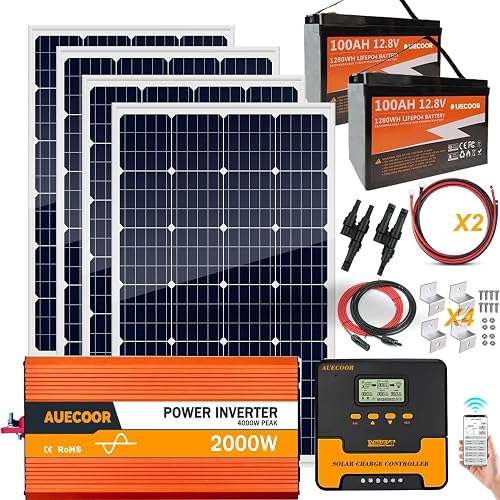
| 1.92kWh Off-Grid Solar Kit (4x120W) | Trailers, campers and marine use | 2560Wh of lithium storage with 2000W inverter |
| 1280Wh Off-Grid Kit with 1000W Inverter | Small rigs and cabin-style setups | Pure sine wave inverter for sensitive electronics |
| ECO-WORTHY 800W Kit with 280Ah Batteries | Heavy daily loads like fridges and induction | 7.168kWh total capacity with 3000W UPS inverter charger |
| ECO-WORTHY 800W Bifacial Kit | Owners wanting higher panel output per square foot | N-type bifacial 195W panels with 314Ah battery |
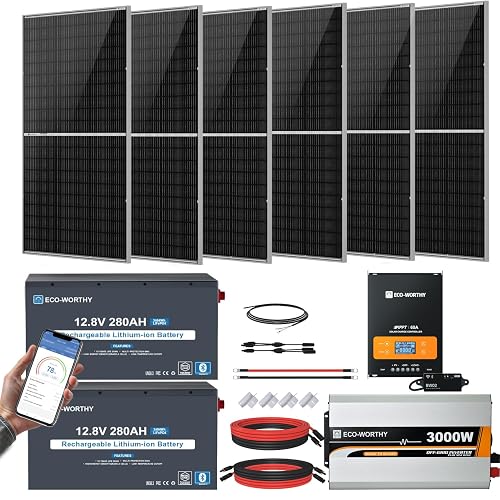
| ECO-WORTHY 1200W 24V Kit | Full-time RVers with larger loads | 24V system with 4.68kWh lithium storage |
ECO-WORTHY 200W Complete Starter Kit with Battery and Inverter
with Battery and Inverter: 2*100W Solar Panel + 30A Charge Controller + 100Ah Lithium Battery + 1100W Premium Solar Inverter ECO-WORTHY 200 Watt 12V Complete Solar Panel Starter Kit for RV Off Grid
Best for: Weekend campers and first-time buyers who want the simplest path to usable power.
This kit suits someone running lights, phone and laptop charging, a small fan, and perhaps a compressor fridge for a few hours a day. It is a sensible entry point if your rig is a small camper or van and your electrical needs are modest.
Key specs
- Two 100W solar panels (200W total)
- 30A charge controller
- 100Ah lithium battery
- 1100W solar inverter
Pros
- Everything needed is included, so there is little guesswork about compatibility.
- The 100Ah lithium battery is light enough to relocate between compartments.
- The 200W array fits on most van or small trailer roofs.
Cons
- 200W of panels will feel limiting if you run an air conditioner or heavy appliances.
- Owners who expand later may need a larger controller.
Bottom line: A strong choice for light users who want a complete, low-complexity system to start with.
1.92KWH Complete Solar Panel Kit for RV Off Grid Solar System
1.92KWH Complete Solar Panel Kit for RV Off Grid Solar System |2x100Ah 12.8V Batteries 2560WH| 4x120W Mono Rigid Solar Panels |2000W Power Inverter|MPPT Controller|Trailer, Camper, Marine
Best for: Trailers, campers and marine use where you want a larger battery bank without building a system from parts.
This kit is aimed at people who camp for a week or more at a time and want enough stored energy to run a fridge overnight, plus lights, water pump and device charging, without running a generator every day.
Key specs
- Four 120W monocrystalline panels (480W total)
- Two 100Ah 12.8V lithium batteries (2560Wh)
- 2000W power inverter
- MPPT charge controller
Pros
- Stored capacity is substantial for the size of the kit.
- MPPT control generally harvests more energy than basic PWM controllers in variable light.
- Listed for trailers and marine use, so it covers several rig types.
Cons
- Four panels need a reasonably large roof or ground mount area.
- Weight of the battery pair should be planned into your rig’s payload.
Bottom line: A good middle ground for campers who need more than a starter system but not a whole-house setup.
1280WH Complete Off-Grid Solar Panel Kit with 1000W Pure Sine Wave Inverter
1280WH Complete Off-Grid Solar Panel Kit with 1000W Pure Sine Wave Inverter, 20A MPPT Controller & 100Ah 12.8V Battery, 2×120W Monocrystalline Solar Panels for RV Boat Cabin Shed Home Backup
Best for: Small rigs and cabin-style setups where sensitive electronics need clean power.
The pure sine wave inverter makes this kit a better fit for laptops, CPAP-style devices and induction cooktops than cheaper modified-sine units. It is well suited to a compact living space with steady, moderate loads.
Key specs
- Two 120W monocrystalline panels (240W total)
- 20A MPPT controller
- 100Ah 12.8V lithium battery (1280Wh)
- 1000W pure sine wave inverter
Pros
- Pure sine wave output is generally gentler on electronics than modified sine wave.
- The 20A MPPT controller is a reasonable match for the 240W array.
- Works for RV, boat, shed and small backup uses alike.
Cons
- 240W of panels recharges slowly on cloudy days.
- Limited headroom if you later want to add a second battery.
Bottom line: Pick this if your loads are steady and electronics-heavy, and you camp in reasonably sunny locations.
4PCS 195W Solar Panels 3000W UPS Inverter Charger 7.168KWH Solar Panel Kit
4PCS 195W Solar Panels, 3000W UPS Inverter Charger, 2PCS 12.8V 280AH Lithium Batteries, 60A MPPT Controller Bluetooth ECO-WORTHY 7.168KWH 800W Solar Panel Kit for RV Off Grid Complete System
Best for: Heavy daily loads such as fridges, induction cooking and power tools.
This is one of the larger kits in the list. It targets people who run a lot of appliances and want a generous battery bank, and who have roof or ground space for four 195W panels.
Key specs
- Four 195W solar panels (780W total)
- Two 12.8V 280Ah lithium batteries
- 3000W UPS inverter charger
- 60A MPPT controller with Bluetooth monitoring
Pros
- Battery capacity is well suited to multi-day off-grid stays.
- The UPS inverter charger can switch to grid or generator power if you have it.
- Bluetooth monitoring makes it easier to track charge state.
Cons
- Total weight and footprint are significant for most RVs.
- Installation is more involved and usually suits a DIY-comfortable owner.
Bottom line: A strong match for buyers with high daily consumption who can accommodate the size and weight.
4PCS N-Type Bifacial 195W Solar Panel with 12.8V 314Ah Lithium Battery
4PCS N-Type Bifacial 195W Solar Panel+12.8V 314Ah Lithium Battery+60A MPPT Charge Controller+2000W Pure Sine Wave Inverter ECO-WORTHY 800W Off Grid Solar System Complete Kit for RV Off Grid
Best for: Owners who want higher panel output per square foot and a large battery bank.
Bifacial panels can capture some reflected light from the ground, which may help on light-colored surfaces or when mounted elevated. This kit suits people who value output density and want a large 314Ah battery.
Key specs
- Four N-type bifacial 195W panels
- 12.8V 314Ah lithium battery
- 60A MPPT charge controller
- 2000W pure sine wave inverter
Pros
- N-type cells are generally associated with good performance in lower light.
- Large battery capacity supports extended off-grid periods.
- Pure sine wave inverter suits sensitive electronics.
Cons
- Bifacial gain depends heavily on mounting height and ground surface, so real results vary.
- Battery weight will need to be planned for in your payload.
Bottom line: Good for owners who can mount panels with clearance underneath and want maximum storage.
6pcs 195W Solar Panels 2Pcs 12.8V 280Ah Lithium Battery 3000W Inverter Off Grid Solar System
6pcs 195W Solar Panels+2Pcs 12.8V 280Ah Lithium Battery+60A MPPT Charge Controller+3000W Pure Sine Wave Inverter [Ultra] ECO-WORTHY 1200W 24V 4.68KWH Lithium Battery Solar System Off Grid
Best for: Full-time RVers and larger loads that need a 24V system.
This is the most capable kit in the list. Six panels, two large batteries and a 24V architecture suit long-term living on the road, where daily consumption is high and the setup is semi-permanent.
Key specs
- Six 195W solar panels (1170W total)
- Two 12.8V 280Ah lithium batteries in a 24V configuration
- 60A MPPT controller
- 3000W pure sine wave inverter
Pros
- A 24V system carries the same power with lower current, which can mean thinner wiring for the same load.
- Panel array output is high enough to recharge large batteries in good sun.
- Pure sine wave inverter handles most household electronics.
Cons
- The six-panel array requires substantial roof space and careful mounting.
- Installation and wiring are best handled by someone experienced with 24V systems.
Bottom line: The right pick for full-time RV living, provided your rig can carry the weight and roof space.
Buying Guide
Battery capacity and usable energy
Lithium batteries are rated in amp-hours at a set voltage, so convert to watt-hours (Ah × V) to compare kits fairly. A 100Ah 12.8V battery holds about 1280Wh nominally. Check whether the listed capacity is nominal or usable, and remember that most lithium chemistries allow a much deeper discharge than lead-acid, which is one reason they feel more capable in practice.
Good picks for this: ECO-WORTHY 200W Complete Starter Kit, 1280Wh Off-Grid Kit with 1000W Inverter
Solar panel wattage and roof space
Panel wattage determines how quickly the battery recharges in good sun. Measure your usable roof area before you buy, and account for vents, air conditioners and the angle needed for good sun exposure. Four to six panels cover most mid-size RVs, but roof space is often the real limit.
Good picks for this: 1.92kWh Off-Grid Solar Kit, ECO-WORTHY 1200W 24V Kit
Inverter type and output
Inverter capacity sets how much you can run at once. Check the continuous rating and any surge rating, and confirm the inverter outputs pure sine wave, which most manufacturers recommend for sensitive electronics. Add up the wattage of appliances you plan to run together and leave headroom.
Good picks for this: 1280Wh Off-Grid Kit with 1000W Inverter, ECO-WORTHY 800W Kit with 280Ah Batteries
Charge controller type
MPPT controllers are generally more efficient than PWM units, especially when panel voltage is higher than battery voltage or when light is variable. A controller’s amperage rating should match or exceed the array’s maximum current. Confirm the controller is compatible with lithium chemistry, since charging profiles differ.
Good picks for this: 1.92kWh Off-Grid Solar Kit, ECO-WORTHY 800W Bifacial Kit
Weight and mounting
Lithium batteries are lighter than lead-acid for the same capacity, but a full kit still adds significant weight. Plan battery placement low and near the center of the rig where possible, and confirm roof mounting hardware and roof load limits. Weight limits are commonly published by RV manufacturers, so check your payload rating.
Good picks for this: ECO-WORTHY 200W Complete Starter Kit, ECO-WORTHY 1200W 24V Kit
Monitoring and expandability
Built-in monitoring, such as Bluetooth readouts, helps you track state of charge and daily harvest. Also think about expansion. Some kits can be augmented with extra panels or batteries, while others are sized as closed systems. Choose a kit that matches where you expect your setup to grow.
Good picks for this: ECO-WORTHY 800W Kit with 280Ah Batteries, ECO-WORTHY 1200W 24V Kit
Installation skill and safety
Wiring a solar system involves high DC current, and lithium batteries require correct protection and fusing. If you are not comfortable with electrical work, have a qualified installer or RV technician review the wiring. Reputable manufacturers typically include fuses or breakers, but confirm they are present and correctly sized.
Good picks for this: ECO-WORTHY 200W Complete Starter Kit, 1280Wh Off-Grid Kit with 1000W Inverter
FAQ
What size rv solar kit with lithium batteries do I need?
Start by listing the watt-hours you use per day: fridge, lights, devices, pump, and any heavy appliances. Add a margin of about 20 percent, then match the battery capacity to that total. For light use, a 100Ah battery is often enough; heavier users typically need 200Ah or more.
Are lithium batteries better than lead-acid for RVs?
Lithium batteries are lighter, can be discharged more deeply, and generally last longer across cycles. They cost more upfront and need a charging profile compatible with lithium chemistry. Many RV owners prefer them for the usable capacity and weight savings.
How many solar panels do I need?
Panel count depends on daily energy use, sun exposure and roof space. As a rough guide, 200W to 400W suits light users, while 800W or more supports heavier daily loads in good sun. Panel output is affected by shading, tilt and weather, so plan with conservative sun-hour estimates.
Can I run an air conditioner on a solar kit?
Most of these kits are not sized for a rooftop air conditioner, which typically draws large amounts of power. A solar kit can run fans, lights and small appliances comfortably, but air conditioning usually requires a much larger system or generator support.
Do I need a pure sine wave inverter?
Pure sine wave inverters are generally recommended for laptops, medical-type devices, and motors that are sensitive to waveform quality. Modified sine wave units can work for simple loads but may cause noise or heating in some electronics.
How long does a lithium battery last?
Manufacturers often specify cycle life, which can be several thousand cycles at a defined depth of discharge. Actual lifespan depends on temperature, charging practices and usage. Storing and charging within the recommended temperature range helps battery longevity.
Conclusion
For most first-time RV owners, the ECO-WORTHY 200W Complete Starter Kit offers a simple, complete path to usable power. Campers who need more stored energy for multi-day trips may prefer the 1.92kWh kit. Owners with electronics-heavy loads should look at the pure sine wave 1280Wh option. Full-time RVers and those running heavy appliances will find the larger 800W and 1200W kits better matched to daily consumption, provided roof space and weight allow. Always compare usable capacity, roof area and inverter rating against your real daily needs before buying.
Sources
- Basics of solar energy, system components and how to size a home or off-grid system (energy.gov)
- Research on solar panel performance, battery storage and off-grid system design (nrel.gov)
- Safety certification standards for electrical equipment and battery systems (ul.com)
Before you buy: helpful guides
Related reading
- Top 6 Best Lithium Batteries for RV Solar System Picks for Every Need
- Solar Panels for Charging RV Batteries: 5 Best Kits for Campers (2026)
- 6 Best RV Solar Panel Kits with Battery and Inverter for Off-Grid Camping (2026)
About Claire Whitaker
Claire Whitaker is part of our editorial team and reviews and edits our small-scale solar guides, checking product details against manufacturer specifications and owner feedback.