 By Miles Sinclair
Updated November 2026
A small solar panel with battery backup lets you store daylight energy and use it later, whether you need power during an outage, at a campsite, or in a van. This list compares six portable solar generators and power stations that pair a panel with a battery. The selection weighs battery capacity, output wattage, charging speed, included panel size and how well each unit suits a specific need.
Best overall: Jackery Solar Generator 1000 v2 and 200W Solar Panel – View on Amazon
Best for a compact camping kit: Jackery Explorer 300 Portable Power Station – View on Amazon
Best for a budget bundle: Jackery Solar Generator 300 and 40W Solar Panel – View on Amazon
Best for home backup: ECOFLOW DELTA 3 MAX Portable Power Station with 220W Solar Panel – View on Amazon
Best for RV and van use: Solar Power Pack 280Wh with 60W Solar Panel – View on Amazon
Best for fast recharging: Jackery Solar Generator 1000 v2 and 100W Solar Panel – View on Amazon
Our Top Picks
| Product | Best for | Key feature |
|---|---|---|
| Jackery Solar Generator 1000 v2 and 200W Solar Panel | Home emergency backup | 1024Wh LiFePO4, 1500W output |
| Jackery Explorer 300 Portable Power Station | Compact camping kit | 292Wh LiFePO4 battery |
| Jackery Solar Generator 300 and 40W Solar Panel | Budget bundle | 292Wh with pure sine wave AC |
| ECOFLOW DELTA 3 MAX Portable Power Station with 220W Solar Panel | Whole-home backup | 2048Wh with 3400W X-Boost |
| Solar Power Pack 280Wh with 60W Solar Panel | RV and van use | 280Wh with USB QC3.0 ports |
| Jackery Solar Generator 1000 v2 and 100W Solar Panel | Fast recharging | 50-minute fast charge |
Jackery Solar Generator 1000 v2 and 200W Solar Panel

Jackery Solar Generator 1000 v2 and 200W Solar Panel,1024Wh LiFePO4 Battery | 1500W (3000W Peak), 50-Min Fast Charge, 10ms UPS Solar Generator for Home Emergency, Camping & RV
Best for: Home emergency backup with a larger battery.
This kit suits households that want to run a refrigerator, lights and devices through a short outage. The listing specifies a 1024Wh LiFePO4 battery and 1500W continuous output with a 10ms UPS switchover.
Pros
- Large 1024Wh capacity for longer runtime
- Specified 50-minute fast charge
Cons
- Heavier than smaller units
Jackery Explorer 300 Portable Power Station

Jackery Explorer 300 Portable Power Station,292Wh | Backup LiFePO4 Battery, Solar Generator for Outdoors, Camping, Travel, Hunting, Blackout (Solar Panel Optional)
Best for: Compact camping kits and light outage use.
This unit fits campers and hikers who need phone, light and small appliance power without a heavy setup. The listing gives a 292Wh LiFePO4 battery with a solar panel sold separately.
Pros
- Light enough for backpacking trips
- Solar panel is optional
Cons
- Limited runtime for high-draw appliances
Jackery Solar Generator 300 and 40W Solar Panel

Jackery Solar Generator 300 and 40W Solar Panel,292Wh,300W AC | Pure Sine Wave AC Outlet, for RV, Outdoors, Camping, Travel, Blackout
Best for: Budget bundles for RV, camping and blackouts.
This pairing suits buyers who want a complete panel and battery kit at a modest scale. The listing specifies 292Wh capacity, 300W AC output and a pure sine wave outlet.
Pros
- Pure sine wave output for sensitive electronics
- Complete kit in one purchase
Cons
- The 40W panel charges slowly in low light
ECOFLOW DELTA 3 MAX Portable Power Station with 220W Solar Panel
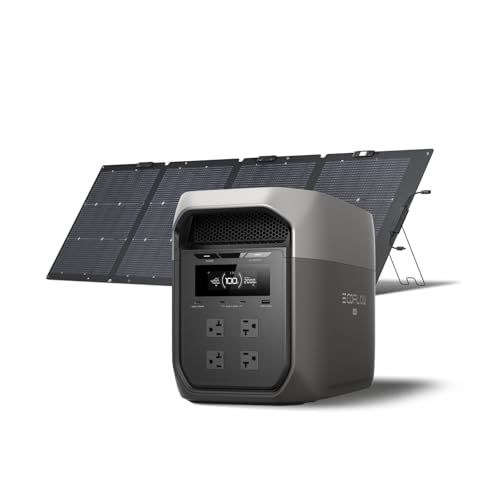
EF ECOFLOW DELTA 3 MAX Portable Power Station with 220W Solar Panel, 2048Wh | 3400W X-Boost Output, Bifacial Solar Panel, Ultra-Fast 0-80% Charging in 1.13 Hr, 2,048Wh LFP Battery, Home Backup Camping
Best for: Whole-home backup with a larger battery.
This option targets homeowners who want to power more circuits during an outage. The listing describes a 2048Wh LFP battery, 3400W X-Boost output and a bifacial 220W panel.
Pros
- Large 2048Wh capacity
- Specified fast 0-80% charging
Cons
- Premium pricing tier
Solar Power Pack 280Wh with 60W Solar Panel

Portable Solar Generator 300W Portable Power Station with 60W Solar Panel | 110V Pure Sine Wave 280Wh Battery Solar Power Pack with USB QC3.0 DC AC Outlet for Camping Smart Device RV Van Outdoor-Orang
Best for: RV and van use with USB charging.
This kit suits van builders and RV owners who need USB and AC outlets in a small footprint. The listing names a 280Wh battery, pure sine wave AC output and a 60W panel.
Pros
- USB QC3.0 ports for phones and tablets
- Compact battery size
Cons
- A 60W panel needs good sun for full charging
Jackery Solar Generator 1000 v2 and 100W Solar Panel

Jackery Solar Generator 1000 v2 and 100W Solar Panel,1024Wh,1500W AC | LiFePO4 Battery, 50-Min Fast Charge, 10ms UPS Solar Generator for Home Emergency, Camping & RV
Best for: Fast recharging between uses.
This kit fits users who want a large battery that refills quickly after heavy use. The listing specifies a 1024Wh battery, 1500W AC output and a 50-minute fast charge.
Pros
- Specified 50-minute fast charge
- Large 1024Wh battery
Cons
- The 100W panel is slower than the 200W option
Buying Guide
Battery Capacity
Battery capacity, measured in watt-hours (Wh), tells you how much energy the unit can store. Match capacity to what you plan to run: a small capacity works for phones, lights and a fan, while larger capacities are better for a refrigerator, medical devices or whole-home backup.
Output Wattage and Outlets
Check the continuous AC output rating so the unit can handle the appliances you want to power at the same time. Also look for the outlet mix you need, such as AC outlets, USB-A, USB-C and DC car ports, and confirm that the inverter produces pure sine wave power if you plan to run sensitive electronics.
Charging Speed and Solar Input
Recharge time depends on both the wall charger and the solar input. Pay attention to the maximum solar input wattage and whether the included panel is large enough to recharge the battery in a reasonable time under typical sunlight at your location.
Portability and Panel Size
If you carry your setup on foot or in a small vehicle, weight and panel folding size matter as much as specs. A lighter power station paired with a foldable panel is easier to move, while a heavier, larger kit usually offers more capacity for home or RV use.
FAQ
Can a small solar panel fully charge a battery backup on its own?
It depends on the panel wattage, the battery size and how much direct sunlight you get. Smaller panels can take a long time to fill a large battery, so many people pair them with a wall charger or a car charger as a backup option.
How long will a battery backup power a refrigerator?
Runtime depends on the refrigerator’s energy use and the battery’s watt-hour capacity. Larger batteries can run a fridge for many hours, but check the appliance’s wattage and your unit’s capacity to estimate a realistic runtime.
What is the difference between a power station and a solar generator?
A power station is the battery and inverter unit, and it can be charged from a wall outlet or car. A solar generator is usually a power station sold together with one or more solar panels to recharge it outdoors.
Do I need a pure sine wave inverter?
A pure sine wave inverter is recommended for sensitive electronics such as laptops, medical equipment and some appliances with motors or digital controls. Simpler devices like lights and basic chargers often run fine on modified sine wave output.
Can these units be used during a power outage?
Many of the units listed are designed for emergency backup, and some offer fast switchover for uninterrupted power to connected devices. Confirm the switchover time and transfer features before relying on a unit for critical equipment.
Conclusion
For a compact camping kit or a light, budget-friendly setup, a smaller power station with a modest solar panel will cover phones, lights and small electronics well. For home backup, RV living or running larger appliances, a higher-capacity unit with a more capable solar input is the better match for longer runtimes.
Start by listing the devices you need to power and how long you need them to run, then choose the battery capacity and output that fit those needs. Pairing that choice with a panel size that matches your sunlight conditions will give you the most reliable results.
Related reading
- Top 6 Small Solar Panel Generators for Camping and Home Backup
- Top 5 Small Solar Panels with Battery for Home Picks for Every Need
- Top 5 Small Solar Panel and Battery Kit Picks for Every Need
- Small Solar Panel with Battery Price: 6 Best Picks Compared (2026)
- How to Connect Small Solar Panel to Battery: A Step-by-Step Guide for Beginners
- How a Small Solar Setup Works: Panel, Controller, Battery, Inverter
About Miles Sinclair
Miles Sinclair is part of our editorial team and reviews and edits our small-scale solar guides, checking product details against manufacturer specifications and owner feedback.