 By Miles Sinclair
Updated November 2026
Choosing a charge controller for small solar panel setups comes down to voltage match, charge mode, load control and how much current your panel can push. This list compares six PWM controllers that cover 12V and 24V systems, with notes on who each one suits. Selection is based on published specifications, brand reputation and common owner feedback patterns, not on bench testing.
Our top picks at a glance
- 1
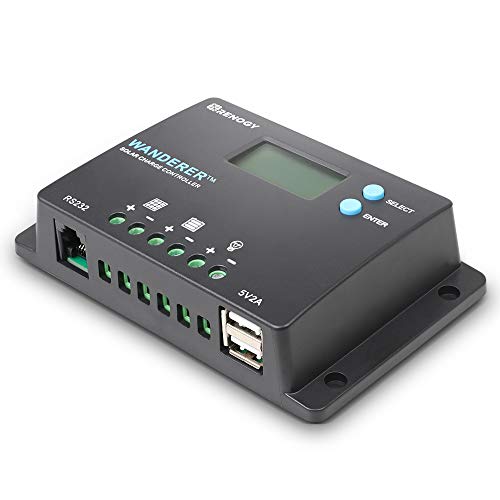 TOP CHOICEBest overallRenogy Wanderer 10A PWM Solar Charge ControllerView on Amazon
- 2
 TOP CHOICEBest for dual USB chargingACEIRMC 2pcs 30A Solar Charge Controller 12V/24VView on Amazon
- 3
 TOP CHOICEBest for timed loads12V/24V Solar Panel Regulator with Dual USB Port Adjustable TimerView on Amazon
- 4
 Best for auto voltage detection30A PWM Solar Charge Controller with Dual USB and LCDView on Amazon
- 5
 Best for multiple load modesPWM Auto Parameter Adjustable 30A Solar Charge ControllerView on Amazon
- 6
 Best for larger arraysSolar Charge Controller 100A 12V 24V 36V 48V Intelligent RegulatorView on Amazon
Our Top Picks
| Product | Best for | Key feature |
|---|---|---|
| Renogy Wanderer 10A PWM | RVs and small battery banks | Multiple battery chemistries |
| ACEIRMC 30A (2-pack) | Phone and device charging | 5V dual USB ports |
| 12V/24V Regulator with Timer | Scheduled lights and pumps | Adjustable on/off timer |
| 30A PWM with LCD | Hands-off auto setup | Automatic parameter detection |
| 30A PWM Auto Parameter | Flexible load control | Multiple load control modes |
| SA100A Intelligent Regulator | Larger arrays | 100A rating, 12V to 48V |
Renogy Wanderer 10A PWM Solar Charge Controller
Renogy Wanderer 10A PWM Solar Charge Controller 12/24V for Solar Panels | 50V PV input, AGM/Gel/Flooded (auto), Li (manual), LCD, overcharge/ short protection, negative ground, temp comp, for RVs
Best for: RVs and small battery banks
This suits owners who want a well-known brand and clear battery-type settings for sealed, flooded, gel or lithium batteries. Manufacturers list a 50V PV input and negative-ground design for mobile use.
Pros
- Selectable battery chemistry, including lithium in manual mode
- Overcharge and short-circuit protection listed
Cons
- 10A rating limits larger panel arrays
ACEIRMC 2pcs 30A Solar Charge Controller 12V/24V
ACEIRMC 2pcs 30A Solar Charge Controller 12V/ 24V Solar Panel Charge Controller Intelligent Regulator with 5V Dual USB Port Display Adjustable Parameter LCD Display and Timer Setting ON/Off Hours
Best for: Phone and device charging
Good for off-grid cabins or sheds where USB charging matters. The two-pack format is useful for running two separate small systems.
Pros
- Built-in 5V dual USB ports
- LCD display with adjustable parameters
Cons
- Owners often report the display settings take some time to learn
12V/24V Solar Panel Regulator with Dual USB Port Adjustable Timer
12V/ 24V Solar Panel Regulator with Dual USB Port Adjustable Timer Setting [Upgraded] 30A PWM Solar Charge Controller with Auto Parameter LCD Display
Best for: Scheduled lights and pumps
Fits garden lighting or small pumps that should run only at set hours. The timer setting is the main reason to choose it over a basic controller.
Pros
- Adjustable on/off timer for loads
- 30A rating with dual USB output
Cons
- PWM design gives less charging efficiency than MPPT units
30A PWM Solar Charge Controller with Dual USB and LCD
30A PWM Solar Charge Controller, 12V 24V Dual USB Solar Panel Battery Intelligent Regulator with LCD Display, Auto Parameter Adjustable, Timer Setting, Multiple Load Control Modes
Best for: Hands-off auto setup
A practical choice for beginners who want the controller to detect system voltage on its own. Listed specs include 12V and 24V compatibility.
Pros
- Auto parameter adjustment reduces manual setup
- Dual USB and timer settings included
Cons
- Listing details on battery types should be checked before buying
PWM Auto Parameter Adjustable 30A Solar Charge Controller
PWM Auto Parameter Adjustable, Multiple Load Control Modes, Dual USB Port with LCD Display, Timer Setting 30A Solar Charge Controller 12V/24V Solar Panel Intelligent Regulator
Best for: Flexible load control
Suits setups that power several loads and need different control modes. It offers the same 12V and 24V range as the other 30A units on this list.
Pros
- Multiple load control modes
- LCD display with timer setting
Cons
- Mode menus can take some time to learn
Solar Charge Controller 100A 12V 24V 36V 48V Intelligent Regulator
Solar Charge Controller 100A 12V 24V 36V 48V Intelligent Recognition LCD Display Battery Intelligent Regulator Maximum 100V Input Dual USB for Lead Acid/Lithium Battery (SA100A)
Best for: Larger arrays
Relevant when a small-panel project grows into a bigger battery bank. Its 100A rating and multi-voltage support make it the heaviest-duty option here.
Pros
- 100A rating and 12V to 48V support
- Dual USB output and LCD display
Cons
- Oversized for a single small panel
Buying Guide
Match the Voltage
Check that the controller supports your battery voltage, usually 12V or 24V. Mismatched voltage is one of the most common setup mistakes.
FAQ
What size charge controller do I need for a small solar panel?
Match the controller’s rated current to your panel’s output and check that it supports your battery voltage, usually 12V or 24V. A controller rated a bit above your panel’s short-circuit current gives you room to grow without overloading the unit.
What is the difference between PWM and MPPT controllers?
PWM controllers are simpler and cost less, and they work well when panel voltage is close to battery voltage. MPPT controllers convert higher panel voltage more efficiently, which can matter in colder weather or with larger arrays, but they are generally more expensive.
Can I use a charge controller with lithium batteries?
Many controllers in this list support lithium batteries, but you may need to set the battery type manually instead of relying on auto detection. Always confirm the charge voltage settings match your specific lithium battery’s requirements before connecting it.
Do I need a charge controller if I have a small solar panel?
Yes, in most cases. Without a controller, a panel can overcharge and damage a battery, and the battery can also drain back through the panel at night. Even a small panel benefits from regulated charging.
What does the timer setting on a charge controller do?
The timer lets you schedule when loads such as lights or USB outlets switch on and off, which helps conserve battery power. It is useful for setups where you want lighting or devices to run only during certain hours.
Is negative grounding important for my setup?
Some controllers are designed for negative ground systems, which is common in RVs and marine applications. Check the wiring requirements of your existing system before buying so the controller fits your ground configuration.
Conclusion
For a simple 12V setup with a small panel and basic load needs, a lower-amp PWM controller with USB outlets and a clear LCD is a practical choice. For larger arrays or systems that need to run 24V or higher-voltage batteries, a higher-current controller with automatic battery recognition will give you more flexibility.
Choose the unit whose current rating, voltage support and load control features match your panel and battery today, with a little headroom for future expansion.
Related reading
- Top 6 Small Solar Panel Controller Picks Compared for Small Projects
- Small Solar Panel to Charge Phone: 6 Best Picks for Travel and Camping (2026)
- How a Small Solar Setup Works: Panel, Controller, Battery, Inverter
About Miles Sinclair
Miles Sinclair is part of our editorial team and reviews and edits our small-scale solar guides, checking product details against manufacturer specifications and owner feedback.