By Claire Whitaker
Updated November 2026
Shopping for a solar panel for condo balcony Singapore use means balancing limited space, strong tropical sun and the rules that govern shared buildings. This list compares seven options against a few practical criteria: physical size and weight, output that suits a small household load, durability in humid and rainy conditions, and how easily each unit can be mounted or moved. Every pick is drawn from published product specifications and common owner feedback patterns, not from our own bench tests.
Our top picks at a glance
- 1
 TOP CHOICEBest overallECO-WORTHY 200 Watts 12 Volt/24 Volt Solar Panel Kit with High EfficieView on Amazon
- 2
 TOP CHOICEBest for grid-tied balcony setups800W Plug-in Balcony Solar Kit (4-Panel) – Grid-Tie Plug and Play SystView on Amazon
- 3
 TOP CHOICEBest for larger roof-style output1200W Plug-in Balcony Solar Kit (6-Panel) – Grid-Tie Plug and Play SysView on Amazon
- 4
 Best for portable charging200W Portable Solar Panel for Power Station, 24% High Efficiency ETFEView on Amazon
- 5
 Best for battery-backed backup44V Monocrystalline Solar Charger Kit, High Efficiency Solar GeneratorView on Amazon
- 6
 Best for compact high-wattage panelsN-Type 16BB 400W Bifacial Solar Panel, 2Pcs 200 Watt Solar Panel for 1View on Amazon
- 7
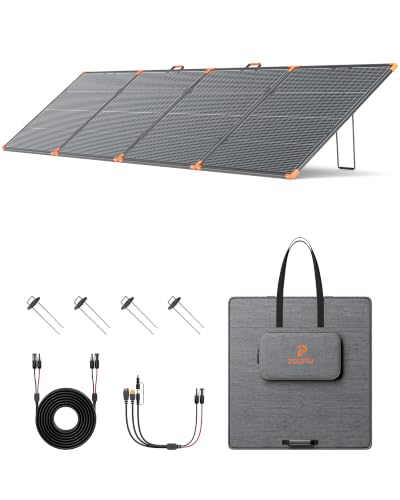 Best for rugged weatherproof useZOUPW 480W Bifacial Portable Solar Panel N-Type 16BB for Power StationView on Amazon
Our Top Picks
Quick Comparison
| Product | Best for | Key feature |
|---|---|---|
| ECO-WORTHY 200 Watts 12V/24V Kit | Overall balance | Includes PWM charge controller |
| 800W Plug-in Balcony Solar Kit (4-Panel) | Grid-tied balcony setups | Plug-and-play microinverter system |
| 1200W Plug-in Balcony Solar Kit (6-Panel) | Higher output needs | Six-panel array with WiFi monitoring |
| 200W Portable Solar Panel for Power Station | Portable charging | Foldable, IP65 waterproof |
| 44V Monocrystalline Solar Charger Kit | Battery backup | Works with power stations |
| N-Type 16BB 400W Bifacial Solar Panel | Compact high wattage | Bifacial, 25.6% stated efficiency |
| 25% Efficiency Foldable Solar Charger | Rugged weatherproof use | IP68 waterproof rating |
ECO-WORTHY 200 Watts 12 Volt/24 Volt Solar Panel Kit with High Efficiency Monocrystalline Solar Panel and 30A PWM Charge Controller
ECO-WORTHY 200 Watts 12 Volt/24 Volt Solar Panel Kit with High Efficiency Monocrystalline Solar Panel and 30A PWM Charge Controller for RV, Camper, Vehicle, Caravan and Other Off Grid Applications
Best for: Overall balance of output and included hardware
A good fit for renters who want a complete kit with the controller already matched to the panel.
Pros
- Includes a 30A PWM charge controller
- Monocrystalline cells with a 12V/24V configuration
Cons
- Mounting hardware and battery sizing are your responsibility
800W Plug-in Balcony Solar Kit (4-Panel) – Grid-Tie Plug and Play System with APsystems Microinverter, WiFi Monitoring & UL 3700 Certification
800W Plug-in Balcony Solar Kit (4-Panel) – Grid-Tie Plug and Play System with APsystems Microinverter, WiFi Monitoring & UL 3700 Certification
Best for: Grid-tied balcony setups with app monitoring
Suits households that want a plug-in system and can confirm local rules with their building management first.
Pros
- Microinverter design simplifies electrical connection
- WiFi monitoring tracks daily output
Cons
- Grid-tie approval may require utility and condo sign-off
1200W Plug-in Balcony Solar Kit (6-Panel) – Grid-Tie Plug and Play System with APsystems Microinverter, WiFi Monitoring & UL 3700 Certification
1200W Plug-in Balcony Solar Kit (6-Panel) – Grid-Tie Plug and Play System with APsystems Microinverter, WiFi Monitoring & UL 3700 Certification
Best for: Higher output needs within a balcony footprint
Better for larger units with generous, unshaded balcony or railing space.
Pros
- Six panels provide greater daily output potential
- Same monitoring and microinverter layout as the 4-panel kit
Cons
- Needs more space and a stronger mounting plan
200W Portable Solar Panel for Power Station, 24% High Efficiency ETFE Foldable Solar Panel Charger
200W Portable Solar Panel for Power Station, 24% High Efficiency ETFE Foldable Solar Panel Charger, QC3.0, Type-C 60W, MC4 Output, IP65 Waterproof, for Outdoor Camping, RV, Emergency Power Supply
Best for: Portable charging for devices and small power stations
Works well for those who want a panel they can move between the balcony, a window and indoor storage.
Pros
- Foldable design with IP65 waterproof rating
- Type-C and QC3.0 outputs for device charging
Cons
- Output is modest for running household appliances
44V Monocrystalline Solar Charger Kit, High Efficiency Solar Generator for Power Station RV Camping Home Balcony Garden ALLPOWERS SP039 600W Foldable Solar Panel
44V Monocrystalline Solar Charger Kit, High Efficiency Solar Generator for Power Station RV Camping Home Balcony Garden ALLPOWERS SP039 600W Foldable Solar Panel
Best for: Battery backup and emergency power
Fits households that already own, or plan to buy, a compatible power station.
Pros
- Foldable monocrystalline panels with a 600W rating
- Designed for pairing with portable power stations
Cons
- Requires a separate battery or station to store energy
Buying Guide
Check whether a grid-tied system is allowed
Before buying any plug-in or grid-tie kit for a condo balcony, confirm with your managing agent or Town Council that a small solar installation is permitted. Shared buildings often have rules about external fixtures, and the decision affects whether a portable panel or a fixed balcony system makes more sense.
Plug-in grid-tie kits also need to meet local electrical requirements, so check that the setup is compatible with your home’s supply and that it has the certifications your utility or installer expects.
Match the output to your household load
Think about what you actually want to power. A portable panel with a power station suits phone charging, lights, a fan or a small appliance, while a larger grid-tie kit is better suited to offsetting part of a daily electricity load. Choosing a wattage far above or below your needs wastes money or leaves you short.
Look at the panel rating together with the rest of the system, such as the charge controller or microinverter, since the combined capacity determines how much usable power you get.
Consider size, weight and mounting
Balconies have limited floor area and load limits, so measure the space and check the panel dimensions and weight. Foldable panels are easier to store and move, while rigid panels need a stable mount that will not shift in strong winds on a high floor.
Make sure the mounting option you choose respects railing and façade rules, and that the panel can be secured against wind gusts common during Singapore’s storms.
Prioritise weather resistance for tropical conditions
Singapore’s humidity, heavy rain and intense sun put steady stress on outdoor equipment. Look for an IP rating that indicates water resistance, along with sturdy frames and connectors that will hold up over years of exposure.
Also check the warranty terms and whether replacement parts are readily available locally, since this affects long-term value more than the initial purchase price.
Think about monitoring and future expansion
Some systems include app-based monitoring that shows real-time output and daily yield, which helps you judge whether the setup is performing as expected. Monitoring is especially useful for grid-tie kits where you want to track how much energy you are offsetting.
If you may want more capacity later, choose a system that can be expanded with additional panels or units rather than one that is a dead end.
FAQ
Can I install a solar panel on my condo balcony in Singapore?
Often yes, but rules vary by building and management. Check with your managing agent or Town Council before installing anything permanent, and confirm that the setup will not block access, obstruct neighbours or breach façade guidelines.
How much power can a balcony solar kit realistically produce?
Output depends on panel rating, sun exposure, orientation and shading from nearby buildings. A balcony rarely gets full sun all day, so actual production is usually lower than the rated figure, and the system’s specifications give the best guide to expected performance.
Is a portable solar panel enough for a small household?
It can be, if your goal is to keep devices charged, run LED lighting or power a few small appliances during outages. It will not replace your main electricity supply, so set expectations based on the load you plan to run.
Do I need a battery with a balcony solar system?
Not always. A grid-tie system feeds excess power into your home supply and does not need a battery, while a portable or off-grid setup usually relies on a power station or battery to store energy for later use.
How do I keep a balcony solar panel safe during Singapore storms?
Secure the panel firmly to the railing or a stable mount, and bring foldable units indoors during heavy winds or typhoon warnings. Regular inspection of cables, connectors and fixings helps prevent damage from wind and rain.
Conclusion
If you want a compact, flexible option for charging devices and running small loads, a portable foldable panel paired with a power station suits most small condo balconies. Choose it when mobility and easy storage matter most.
If you want to offset part of your daily electricity use and your building permits it, a plug-in grid-tie balcony kit is the better fit, especially if you value app-based monitoring and room to expand later.
Related reading
- Top 5 NJ Balcony Solar Panels for New Jersey Apartments and Condos
- Solar Panel Condo Balcony Set Up: A Step-by-Step Guide for Beginners
- Solar Panel Condo Balcony Picks: 6 Best Options Compared (2026)
- Solar Panel Condo Balcony Philippines: A Step-by-Step Guide for Beginners
- Balcony Solar Panels Singapore: A Step-by-Step Guide for Beginners
- Top 7 Solar Panels for Balcony Picks for Apartments and Small Spaces
- Top 6 Solar Panels for Balcony UK Compared for Apartments (2026)
About Claire Whitaker
Claire Whitaker is part of our editorial team and reviews and edits our small-scale solar guides, checking product details against manufacturer specifications and owner feedback.