 By Miles Sinclair
Updated November 2026
Choosing a small solar panel kit with battery and inverter can feel confusing, because every listing mixes panel wattage, battery capacity and inverter output into one headline. This list focuses on what matters most for a small setup: how much power the kit produces, how much it can store, whether the inverter can run your loads, and whether the included parts suit RVs, sheds, cabins or backup use.
Our top picks at a glance
- 1
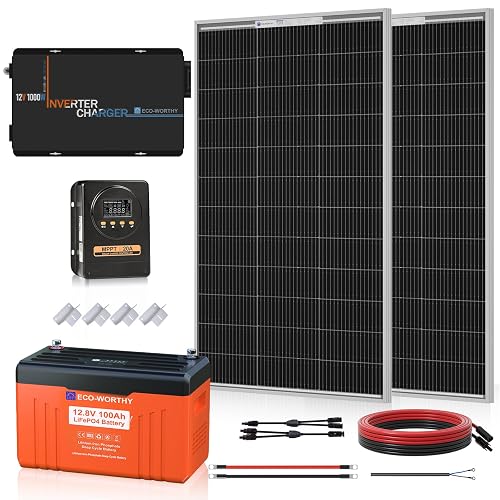 TOP CHOICEBest overallECO-WORTHY 12V 200W Solar Panel Kit with Battery and InverterView on Amazon
- 2
 TOP CHOICEBest for RV starter setupsECO-WORTHY 200 Watt 12V Complete Solar Panel Starter Kit for RV Off GridView on Amazon
- 3
 TOP CHOICEBest for cabins and sheds1280WH Complete Off-Grid Solar Panel Kit with 1000W Pure Sine Wave InverterView on Amazon
- 4
 Best for larger RV or trailer useECO-WORTHY 12 Volt 400W Complete Solar Panel Kit for RV Off Grid TrailerView on Amazon
- 5
 Best for basic 12V chargingECO-WORTHY 200 Watts 12 Volt/24 Volt Solar Panel KitView on Amazon
- 6
 Best for light loadswith Battery and Inverter: 200W Solar Panels+30A Charge Controller+50AView on Amazon
- 7
 Best for whole-home backupWhole House System:10KW 120V/240V Split Phase Solar Inverter| 48V 314AView on Amazon
Our Top Picks
Quick Comparison
| Product | Best for | Key feature |
|---|---|---|
| ECO-WORTHY 12V 200W Kit with Battery and Inverter | Overall balance | 100Ah lithium, 2000W inverter |
| ECO-WORTHY 200W Starter Kit for RV | RV starter setups | 100Ah battery, 1100W inverter |
| 1280Wh Off-Grid Solar Kit | Cabins and sheds | 1000W pure sine wave inverter |
| ECO-WORTHY 12V 400W Complete Kit | Larger trailers | 280Ah battery, 40A MPPT |
| ECO-WORTHY 200W 12V/24V Kit | Basic 12V charging | 30A PWM controller |
| ECO-WORTHY 200W Starter Kit with 50Ah Battery | Light loads | 600W inverter, compact |
| ECO-WORTHY 10kW Whole House Kit | Whole-home backup | 16kWh storage, split-phase output |
ECO-WORTHY 12V 200W Solar Panel Kit with Battery and Inverter
2 PCS 100W Solar Panel,12V 100Ah Lithium Battery,Upgrade 2000W 12V Inverter,20A MPPT Controller with Bluetooth ECO WORTHY 12V 200W Solar Panel Kit with Battery and Inverter
Best for: Overall balance of panels, storage and inverter output in one package.
This kit suits people who want a complete starting point for a van, shed or small off-grid corner without matching parts separately.
Pros
- Includes 100Ah lithium battery and 2000W inverter
- Bluetooth-enabled 20A MPPT controller
Cons
- Panel output is modest for heavy daily loads
ECO-WORTHY 200 Watt 12V Complete Solar Panel Starter Kit for RV Off Grid
ECO-WORTHYwith Battery and Inverter: 2*100W Solar Panel + 30A Charge Controller + 100Ah Lithium Battery + 1100W Premium Solar Inverter 200 Watt 12V Complete Solar Panel Starter Kit for RV Off Grid
Best for: RV starter setups that need a battery and inverter in one box.
Owners who are new to RV solar often choose this kit because the parts are sized to work together with a 30A controller.
Pros
- Includes 100Ah lithium battery and 1100W inverter
- Two 100W panels for roof or ground mounting
Cons
- Inverter output limits high-draw appliances
1280WH Complete Off-Grid Solar Panel Kit with 1000W Pure Sine Wave Inverter
1280WH Complete Off-Grid Solar Panel Kit with 1000W Pure Sine Wave Inverter, 20A MPPT Controller & 100Ah 12.8V Battery, 2×120W Monocrystalline Solar Panels for RV Boat Cabin Shed Home Backup
Best for: Cabins, sheds and small backup systems that power sensitive electronics.
A pure sine wave inverter is the better match for laptops, medical devices and other equipment that dislikes modified waveforms.
Pros
- Pure sine wave inverter suits sensitive electronics
- 1280Wh storage for overnight loads
Cons
- Two 120W panels take time to recharge the battery on cloudy days
ECO-WORTHY 12 Volt 400W Complete Solar Panel Kit for RV Off Grid Trailer
4 * 100W Solar Panel + 40A MPPT Controller + 12V 280Ah Lithium Battery + 2000W Power Inverter [Ultra]ECO-WORTHY 12V 400W Complete Solar Panel Kit for RV Off Grid Trailer
Best for: Larger trailers and RVs that need more daily energy.
Four 100W panels and a 280Ah battery give this kit more room for fridges, fans and lighting than smaller starter sets.
Pros
- Four 100W panels and 40A MPPT controller
- 280Ah battery offers substantial storage
Cons
- Heavier and bulkier to mount than smaller kits
ECO-WORTHY 200 Watts 12 Volt/24 Volt Solar Panel Kit
ECO-WORTHY 200 Watts 12 Volt/24 Volt Solar Panel Kit with High Efficiency Monocrystalline Solar Panel and 30A PWM Charge Controller for RV, Camper, Vehicle, Caravan and Other Off Grid Applications
Best for: Basic 12V charging for campers, caravans and small vehicles.
This kit is aimed at people who mainly want to keep batteries topped up rather than run an inverter-based household.
Pros
- Works with both 12V and 24V systems
- 30A PWM controller is simple to set up
Cons
- Listing does not center on a built-in battery and inverter
Buying Guide
Panel Wattage and Daily Energy Needs
Start by estimating how much energy you use each day in watt-hours. The panel wattage in a kit tells you how fast it can recharge the battery under good sun, so match it to the loads you plan to run. A kit with more panels will charge faster, but real output always depends on sunlight, angle, and weather.
Battery Capacity and Chemistry
The battery determines how long your devices can run without sun. Lithium batteries are lighter, last longer over many cycles, and can usually be discharged more deeply than lead-acid types, which makes them a common choice for small kits. Check the listed voltage and amp-hour rating so you understand the true stored energy.
Inverter Output and Surge Capacity
The inverter converts battery power into household-style AC electricity. Make sure its continuous wattage covers your heaviest running load at the same time, and look at surge rating for motors or compressors that need a brief burst of extra power. Pure sine wave inverters are generally the safer choice for sensitive electronics.
Charge Controller Type
The charge controller protects the battery and manages how power flows from the panels. MPPT controllers typically harvest more energy from the panels than PWM controllers, especially in cooler or low-light conditions. Confirm that the controller’s amp rating suits the panel array and battery voltage in the kit.
Intended Use and Installation Space
Think about where the system will live, whether that is an RV roof, a shed, a cabin, or a home backup setup. Consider panel size, mounting options, cable lengths, and how easy it will be to expand later. A kit that fits your space and use case will serve you better than one with the biggest headline numbers.
FAQ
Can a small solar panel kit with battery and inverter power a refrigerator?
Many small kits can run a compact refrigerator for part of the day, but results depend on the fridge’s energy use and how much sun you get. Check the fridge’s listed power draw and daily energy use before you buy. Running it continuously may require more panels or battery capacity than a small kit provides.
How many panels do I need for my setup?
The right number depends on your daily energy use and your location’s sunlight hours. Calculate your daily watt-hour needs, then compare that to the kit’s expected daily output under typical sun. Adding a panel or two gives you a buffer for cloudy days.
Is lithium or lead-acid battery better for a small kit?
Lithium batteries are lighter, last longer, and can be discharged more deeply, which is why many modern kits use them. Lead-acid batteries cost less upfront but are heavier and need more care to last. Your budget, weight limits, and how often you cycle the battery should guide the choice.
Do I need a pure sine wave inverter?
A pure sine wave inverter produces clean power similar to a home outlet, which is better for laptops, medical devices, and other sensitive electronics. Modified sine wave inverters can work for simple loads but may cause problems with some devices. For most people, pure sine wave is the safer and more versatile option.
Can I expand a kit later?
Many kits can be expanded by adding panels or batteries, but you must confirm that the charge controller and inverter can handle the larger system. Check voltage compatibility and maximum input limits before adding components. Planning for expansion from the start can save you from replacing equipment later.
Conclusion
For most RV and off-grid users who want a simple, balanced starter system, a 200W kit with a 100Ah lithium battery and an inverter is a practical place to begin. Those who need more power for a cabin, shed, or backup setup should look at the larger 1280Wh or 400W kits, while buyers with very light needs can consider the smaller 200W 12V/24V option.
Whichever kit you choose, match its panel output, battery capacity, and inverter rating to your real daily loads, and confirm that the controller and wiring suit the system. Taking a few minutes to run the numbers will help you pick the setup that fits your space and budget best.
Related reading
- How a Small Solar Setup Works: Panel, Controller, Battery, Inverter
- 6 Best Small Solar Panel 12V Battery Charger Kits for Cars, Boats and RVs (2026)
- Solar Panel Kits for Small Cabin: A Step-by-Step Buyer's Guide
- Solar Panel Kit for Small House: 7 Steps to Pick the Right Setup
- Small Solar Panel with Battery Price: 6 Best Picks Compared (2026)
About Miles Sinclair
Miles Sinclair is part of our editorial team and reviews and edits our small-scale solar guides, checking product details against manufacturer specifications and owner feedback.