 By Claire Whitaker
Updated November 2026
Outdoor solar lights ideas can transform a dark yard into a space you actually want to use after sunset. In this guide, you will learn seven practical ways to place solar lights, how to match fixtures to each spot, and how to avoid the mistakes that leave lights dim or dead by midnight. Most of these projects need no wiring, no trenching and no electrician, which makes them a good fit for weekend work.
Start by Mapping How You Use the Space
Before buying anything, walk your yard after dark with a flashlight and note where you actually go. Most people use a handful of routes: the path from the driveway to the front door, the back steps, the spot where they grill, and the bench where they sit with coffee. Lighting those zones first gives you the biggest improvement for the least effort.
Shopping for one? See our guide: Top 5 Solar Lights for Balcony Picks for Small Outdoor Spaces.
Sketch a rough map on paper. Mark trip hazards like roots, stone steps and uneven pavers. Mark areas that feel unsafe or hard to read. Then decide which spots need functional light (walking and cooking) and which need atmosphere (seating and trees).
Checklist for your zone map
- Entry paths and walkways
- Stairs, steps and ramps
- Patio, deck or seating area
- Garden beds you want to show off
- Fence lines and gate latches
- Trees, shrubs or a statue you want highlighted
Idea 1: Border a Walkway With Path Lights
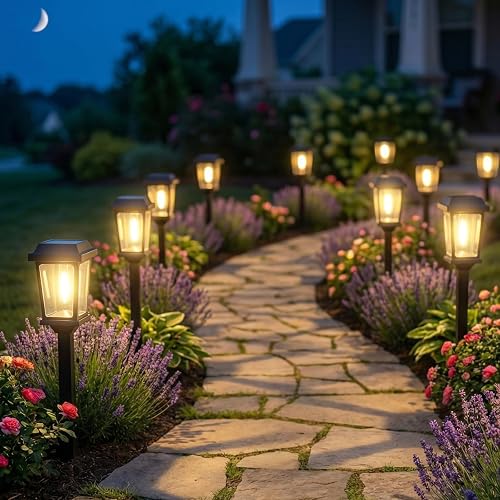
Stake-style path lights are the classic starting point. Space them roughly 6 to 8 feet apart on each side of a walkway, staggering them so light pools on the ground rather than creating a line of bright dots. Many manufacturers specify a light spread of a few feet in diameter, so overlapping circles give even coverage.
For a more detailed look at spacing and fixture styles, see Top 5 Outdoor Solar Lights Pathway Picks for Walkways and Yards (2026) and Top 7 Solar Powered Outdoor Path Lights for Walkways and Yards.
Placement tips for path lights
- Set the fixture so the solar panel faces the sun during the day, usually the southern sky in the Northern Hemisphere.
- Keep the panel clear of shadows from fences, eaves and shrubs.
- Push stakes at least 4 to 6 inches into soil so they do not tip in wind.
Idea 2: Light Steps With Low Recessed or Surface Lights
Steps are where falls happen, so they deserve dedicated light. Small solar deck or step lights mounted on the riser or the edge of each tread show the change in height without glare. Choose warm white or soft amber for a calmer look, and avoid placing lights where they shine straight into eyes as people approach.
If your steps are on a sloped lot, consider lights that angle downward. Keep the fixture spacing consistent, usually one light per step or every other step on a wide staircase.
Idea 3: Wrap Trees and Shrubs in String Lights
Solar string lights are one of the easiest ways to add a soft canopy to a patio or backyard. Wrap them loosely around a tree trunk or drape them through a pergola. For a closer look at how these behave in real yards, read Top 4 Outdoor String Lights Solar Power Picks for Patios and Yards.
Keep the solar panel on the sunniest part of the string, often the top of a tree or the edge of a pergola. A panel hidden in deep shade will leave the lights dim after one or two nights of use.
Idea 4: Hang Pendant or Lantern Lights Over Seating
Hanging lights add height to a patio and draw the eye upward, which makes a small space feel larger. Hooks or a shepherd’s hook work well for lanterns, and a covered porch is a good spot for pendant-style fixtures. Many hanging units are rated for outdoor use, but confirm the ingress protection rating on the packaging before you mount one in a spot that gets direct rain.
Helpful reading includes Top 7 Solar Pendant Lights Outdoors for Patios and Porches and Top 6 Waterproof Outdoor Solar Hanging Lights for Patios and Yards.
Idea 5: Use Spotlights to Accent Architecture or Plants
A small solar spotlight aimed at a column, a stone wall or a specimen plant creates depth. Aim the beam at an angle of about 30 to 45 degrees to the surface so you see texture rather than a flat wash of light. Spotlights draw more power, so they work best in full sun spots with a panel that can charge them fully.
For specific options and aiming tips, see Top 6 Solar Lights Outdoor Spotlight Picks for Yards and Pathways.
Idea 6: Create a Color Accent Zone
Color-changing solar lights can set a mood for parties or seasonal décor. Use them sparingly, perhaps around a fire pit or a single garden bed, so the effect stays special. Many owners report that color modes drain batteries faster, so set them to a single steady color for everyday use.
Browse Top 6 Solar Powered Color Changing Outdoor Lights for Gardens and Yards for ideas that suit different garden styles.
Idea 7: Add Motion-Activated Security Lighting
Motion sensors turn a light on when someone approaches, which saves battery and adds a sense of security. Mount these near side gates, sheds or garage doors. Position the sensor so it does not face a busy street, since headlights and passing cars can trigger it repeatedly.
Explore Solar Powered Outdoor Lights with Motion Sensor: 7 Best Picks (2026) for models that suit this use. If your garage is a key entry point, Solar Powered Outdoor Garage Lights: 7 Steps to a Brighter Driveway covers placement in more detail.
Choosing the Right Fixture for Each Spot
Not every solar light fits every location. Use the table below to match a spot with a light type and a rough brightness target. Brightness is often listed in lumens on packaging, and higher numbers suit task areas more than decorative ones.
| Location | Best light type | Typical lumen range (manufacturer-listed) | Placement note |
|---|---|---|---|
| Walkway | Stake path light | Low to moderate | Space 6 to 8 feet apart |
| Steps | Step or deck light | Low | One per riser or every other step |
| Patio seating | Hanging lantern or string | Low to moderate | Keep panel in direct sun |
| Garden accent | Spotlight | Moderate to high | Angle 30 to 45 degrees to surface |
| Side gate or shed | Motion-sensor light | Moderate | Avoid aiming at a road |
Common Mistakes to Avoid
- Mounting the panel in shade. Even partial shade from a fence can cut charging dramatically. Check the spot at midday.
- Overlighting. Too many lights wash out the effect. Start with fewer fixtures and add more only if needed.
- Ignoring winter sun. Days are shorter and the sun sits lower in cold months. Lights that work in July may struggle in December.
- Using cheap batteries. Replacement batteries matter. Use the type the manufacturer specifies, and replace them when runtime drops noticeably.
- Forgetting the weather rating. Check the ingress protection rating before placing a light in a spot that gets heavy rain, sprinklers or snow.
Tips for Better Results
- Clean panels every month or two with a soft cloth and water. Dust and pollen reduce output.
- Test each light at night before committing to final placement.
- Group lights in odd numbers, such as three or five, for a more natural look.
- Mix a few warm white lights with a bit of cooler white for depth.
- Keep a spare battery on hand so one dead unit does not leave a gap.
Recommended gear
These tools and supplies make installation easier and more reliable.
- Stake-mounted solar path lights give you a flexible way to line walkways without drilling. View on Amazon
- Solar string lights with a remote panel let you place the panel in full sun while the lights hang in shade. View on Amazon
- Adjustable solar spotlight helps you aim the beam at a tree or wall with precision. View on Amazon
- Soft-bristle cleaning brush keeps solar panels clear of dust so charging stays consistent. View on Amazon
FAQ
How many hours of sun do outdoor solar lights need?
Most manufacturers recommend a full day of direct sun to charge the battery fully. Partial shade or cloudy days still charge the light, but runtime at night will be shorter.
How far apart should solar path lights be placed?
A common starting point is 6 to 8 feet apart, staggered on alternating sides. Adjust based on the light’s spread and how bright you want the path to feel.
Why do my solar lights stop working after a few months?
The rechargeable battery may be wearing out, or the panel may be dirty or shaded. Clean the panel, check placement, and replace the battery if the manufacturer specifies a replacement type.
Can solar lights stay outside in winter?
Most outdoor models are built to handle cold weather, but charging slows in short, cloudy days. Expect shorter runtimes and consider moving lights to a sunnier spot if possible.
Do solar lights work under a covered porch?
Usually not well, because the panel needs direct sunlight. A remote panel mounted in an open area and wired to the light can solve this problem.
Are color-changing solar lights worth it?
They are fun for special occasions and seasonal décor. For daily use, a steady warm white setting often gives better battery life and a calmer look.
How do I know if a light is waterproof enough?
Check the ingress protection (IP) rating printed on the packaging. Higher numbers indicate better protection against dust and water. For a light in a spot that sees sprinklers or heavy rain, choose a model rated for that exposure.
Conclusion
Outdoor solar lights ideas work best when you match each fixture to a specific job: guiding feet, lighting steps, softening seating areas, or highlighting plants. Start with the routes you use most, then add accents once the basics are covered. A little planning around sun exposure and placement will keep your lights bright through the seasons.
Ready to choose one?
About Claire Whitaker
Claire Whitaker is part of our editorial team and reviews and edits our small-scale solar guides, checking product details against manufacturer specifications and owner feedback.