By Claire Whitaker
Updated November 2026
If you want to know whether you can run an RV air conditioner on solar, the honest answer is that it depends on the AC’s startup surge, its running draw and how much battery and panel capacity you have. Most RV roof units pull far more power when the compressor kicks on than they do once running, so the right RV solar to run AC setup has to handle both numbers. The picks below were chosen by reviewing manufacturer specifications, brand reputation and the patterns owners commonly describe, with a focus on inverter output, surge rating, battery capacity and included solar input. We did not run these units ourselves; everything here comes from published listing details and general owner feedback.
Our top picks at a glance
- 1
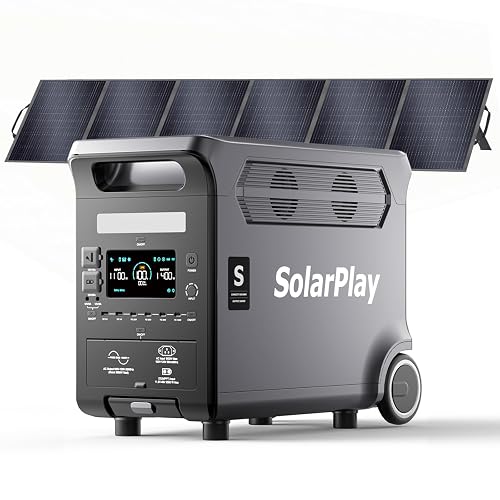 TOP CHOICEBest overallSolarPlay Q3600 Portable Power Station with 400W Solar PanelView on Amazon
- 2
 Best for larger rigsLCD Display, 23 ft Wired Remote, Dual AC and 20A Outlets, Hardwire Port Power InverterView on Amazon
- 3
 Best budget pickJackery Solar Generator 300 with 40W Solar PanelView on Amazon
- 4
 Best for light loadsPortable AC Outlet Camping Solar Power Bank 146Wh with 40W Solar PanelView on Amazon
Our Top Picks
Quick Comparison
| Product | Best for | Key feature |
|---|---|---|
| SolarPlay Q3600 Portable Power Station with 400W Solar Panel | Full-size roof AC on a larger rig | 3600W AC output with 3840Wh LiFePO4 battery |
| LCD Display, 23 ft Wired Remote, Dual AC and 20A Outlets, Hardwire Port Power Inverter | Hardwired installs with a battery bank | 3000W pure sine wave inverter with hardwire port |
| Jackery Solar Generator 300 with 40W Solar Panel | Small AC units and fans on a budget | 292Wh battery with 300W AC output |
| Portable AC Outlet Camping Solar Power Bank 146Wh with 40W Solar Panel | Fans, lights and electronics | 146Wh battery with bundled 40W solar panel |
SolarPlay Q3600 Portable Power Station with 400W Solar Panel
SolarPlay Q3600 Portable Power Station with 400W Solar Panel, 3600W AC Output(Surge 5500W) 3840Wh LiFePO4 Battery Solar Generator, Essential Home Backup for Home Use, Power Outages, RV, Camping
For a deeper look, 7 Best 24V LiFePO4 Battery Chargers for RV, Solar and Off-Grid Use (2026) covers this in detail.
Best for: Full-size roof AC on a larger rig
This is the most capable option on the list and suits owners who want to run a full-size RV air conditioner with a real margin for surge. It is also a solid home backup unit, so it works for users who split time between camp and home.
Key specs
- 3600W AC output, 5500W surge (per listing)
- 3840Wh LiFePO4 battery capacity
- Bundled 400W solar panel
Pros
- Enough capacity to run an AC for several hours on a full charge, depending on load
- LiFePO4 chemistry is generally associated with long cycle life
- Large solar input shortens recharge time in good sun
Cons
- Heavy and bulky compared with smaller units
- Full AC running time depends heavily on sun and load management
Bottom line: Pick this if you have a full-size roof AC and want the most headroom. Expect to pair it with careful load planning.
LCD Display, 23 ft Wired Remote, Dual AC and 20A Outlets, Hardwire Port Power Inverter
LCD Display, 23 ft Wired Remote, Dual AC and 20A Outlets, Hardwire Port, USB, Power Inverter for Solar, Off-Grid, RV, Truck 3000W Pure Sine Wave Inverter 12V DC to 120V AC, 6000W Peak
Best for: Hardwired installs with a battery bank
This is an inverter rather than an all-in-one generator, so it fits owners who already have or plan to build a 12V battery bank and solar array. The hardwire port and remote display suit a more permanent setup.
Key specs
- 3000W continuous pure sine wave output (6000W peak, per listing)
- 12V DC input to 120V AC output
- Dual AC outlets, 20A outlets and a hardwire port
Pros
- Pure sine wave output is generally preferred for sensitive electronics and compressors
- Wired remote lets you monitor from inside the rig
- Hardwire port supports a cleaner installation
Cons
- Inverter alone does not store energy; you need a separate battery bank sized for your AC
- Installation involves 12V wiring and should be handled by someone comfortable with DC systems
Bottom line: A good fit for owners building a permanent solar and battery system who want a flexible inverter core.
Jackery Solar Generator 300 with 40W Solar Panel
Pure Sine Wave AC Outlet, for RV, Outdoors, Camping, Travel, Blackout Jackery Solar Generator 300 and 40W Solar Panel,292Wh,300W AC
Best for: Small AC units and fans on a budget
This smaller power station suits owners with compact or low-draw cooling, such as a small window-style unit, a fan or a fridge alongside. It is a budget pick for shorter trips rather than a full roof AC.
Key specs
- 292Wh battery capacity
- 300W AC output
- Bundled 40W solar panel
Pros
- Lightweight and easy to move between campsites
- Simple plug-and-play setup with the included panel
- Good for fans, lights, phones and small appliances
Cons
- Capacity is too small to run a standard roof AC for any meaningful time
- Recharge from a 40W panel is slow in anything but strong sun
Bottom line: Choose this if your cooling needs are modest and you mainly want to run fans or a small unit for a few hours.
Portable AC Outlet Camping Solar Power Bank 146Wh with 40W Solar Panel
Portable AC Outlet Camping Solar Power Bank 146Wh DC Battery Pack for Smart Device RV Outdoor Power Outage with Solar Charger Portable Power Station with 40W Solar Panel, 100W Solar Powered Generator
Best for: Fans, lights and electronics
This is the lightest option here and fits campers whose main goal is keeping devices, lights and a fan running rather than a true air conditioner. Treat it as a supplement, not a primary cooling solution.
Key specs
- 146Wh battery capacity
- Portable AC outlet plus DC and USB ports
- Bundled 40W solar panel
Pros
- Very portable and simple to set up
- Covers phones, lights and small fans well
- Low-cost entry point for solar power at camp
Cons
- Not sized for a roof air conditioner, which can drain this battery in well under an hour
- Small solar input means slow recharging
Bottom line: A useful add-on for light loads, but not a realistic answer to running an RV AC on solar.
Buying Guide
Check the AC’s startup surge, not just its running watts
Roof air conditioners draw a large spike when the compressor starts. Look up the unit’s nameplate or manual for running and starting amps, then confirm the inverter’s surge rating covers that spike. An inverter that handles the running load but not the surge will shut down at startup.
Good picks for this: SolarPlay Q3600 Portable Power Station with 400W Solar Panel, LCD Display Power Inverter 3000W
Battery capacity and realistic runtime
Runtime is roughly battery watt-hours divided by the AC’s average draw, minus inverter losses. A 292Wh battery will run a small load for a short time but will not sustain a roof AC. Larger lithium capacity gives you more room, but it still needs sun or a generator to recharge.
Good picks for this: SolarPlay Q3600 Portable Power Station with 400W Solar Panel, Jackery Solar Generator 300 with 40W Solar Panel
Inverter type: pure sine wave matters
Pure sine wave output is generally recommended for compressors and sensitive electronics. Modified sine wave units can cause motor overheating or erratic operation in some appliances. Check the listing for the waveform type before buying.
Good picks for this: LCD Display Power Inverter 3000W, Jackery Solar Generator 300 with 40W Solar Panel
Solar input and recharge time
A 40W panel in full sun may deliver only a fraction of its rating over a day once you account for angle, shade and heat. Larger arrays recharge faster, but roof space on an RV is limited. Plan for recharge time in your daily energy budget.
Good picks for this: SolarPlay Q3600 Portable Power Station with 400W Solar Panel, Portable AC Outlet Camping Solar Power Bank 146Wh with 40W Solar Panel
Size and mounting fit
Portable power stations are easy to move but take up floor or storage space. Hardwired inverters need a dedicated spot, cable runs and proper fusing. Measure your storage area before you commit.
Good picks for this: LCD Display Power Inverter 3000W, Portable AC Outlet Camping Solar Power Bank 146Wh with 40W Solar Panel
Use case: full-time, weekend or occasional
Full-time boondockers need more capacity and a complete system. Weekend campers often just need enough to run fans and lights. Match the unit to how often and how long you plan to run cooling.
Good picks for this: Jackery Solar Generator 300 with 40W Solar Panel, SolarPlay Q3600 Portable Power Station with 400W Solar Panel
Durability and battery chemistry
LiFePO4 batteries are commonly associated with longer cycle life than some other lithium chemistries. Look for solid enclosures and clear warranty terms. Keep units out of direct heat, and store them according to the manufacturer’s temperature guidance.
Good picks for this: SolarPlay Q3600 Portable Power Station with 400W Solar Panel, LCD Display Power Inverter 3000W
FAQ
Can I run my RV AC on solar?
Yes, but only with a system sized for the AC’s surge and running draw, plus enough battery and solar input to sustain it. Small power stations generally cannot run a standard roof unit for long.
Can you run RV AC on solar without a generator?
It is possible with a large enough battery bank and solar array, but many owners still keep a generator as backup for cloudy days or heavy cooling demand.
Can RV AC run on solar power alone during the day?
Solar panels can supply power directly during sunny hours, but the AC’s peak demand often exceeds what a modest array produces at once. A battery buffer helps smooth the load.
What size inverter do I need for an RV air conditioner?
Check the AC’s starting and running amps from its label, convert to watts at 120V, and choose an inverter with continuous output and surge capacity above those figures. Leave headroom for other loads.
Is a portable power station enough to run an RV AC?
Larger units with high AC output and large battery capacity can run a roof AC for limited periods. Smaller units are better suited to fans, lights and electronics.
How long will a battery run an RV air conditioner?
Runtime depends on battery watt-hours, inverter efficiency, the AC’s real draw and outside temperature. Estimate by dividing usable battery energy by the AC’s average wattage, then plan for less.
Conclusion
For most RV owners asking about RV solar to run AC, the realistic path is a large power station or a hardwired inverter with a proper battery bank and solar array. The SolarPlay Q3600 Portable Power Station with 400W Solar Panel offers the most headroom for a full-size roof unit. The LCD Display Power Inverter 3000W suits owners building a permanent system. The Jackery Solar Generator 300 with 40W Solar Panel and the 146Wh Portable AC Outlet Camping Solar Power Bank are better for fans, lights and small loads. For more context, read RV Solar Air Conditioning: Can Solar Run Your AC? (Step-by-Step) and Solar Powered AC for RV: 5 Best Picks Compared for Every Need (2026).
Consult a qualified RV electrician or solar installer before making hardwired changes to your rig’s electrical system.
Sources
- Background on battery storage, solar energy basics and system planning (energy.gov)
- Research on photovoltaic performance and energy system design (nrel.gov)
- Electrical safety standards relevant to RV and portable power installations (nfpa.org)
Before you buy: helpful guides
Related reading
- Solar RV AC Unit Picks: 5 Best Options for Off-Grid Cooling (2026)
- Solar Panels for RV AC: 7 Best Picks for Off-Grid Cooling (2026)
About Claire Whitaker
Claire Whitaker is part of our editorial team and reviews and edits our small-scale solar guides, checking product details against manufacturer specifications and owner feedback.