By Claire Whitaker
Updated November 2026
Choosing an rv solar power kit can feel overwhelming when every listing promises the same thing. This list focuses on complete kits that bundle panels, a charge controller, and in several cases a battery and inverter, so you can compare what you actually get. Selection was based on product listings, brand reputation, and patterns in owner feedback, with attention to panel wattage, controller type, battery capacity, and whether the kit suits a small camper or a larger off-grid rig.
Our top picks at a glance
- 1
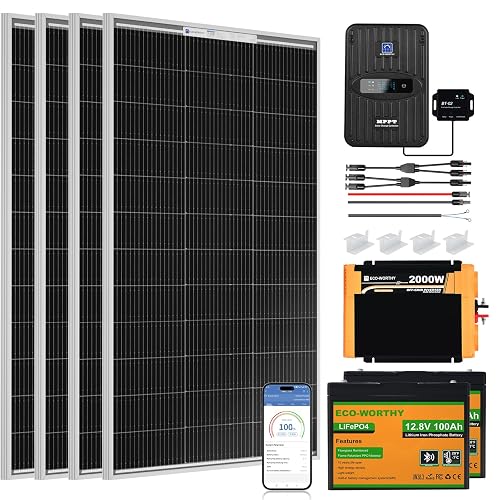 TOP CHOICEBest overallECO-WORTHY 1.6KWH Complete Solar Panel Kit 400W 12VView on Amazon
- 2
 TOP CHOICEBest for a basic starter setupECO-WORTHY 200 Watt 12 Volt/24 Volt Solar Panel KitView on Amazon
- 3
 TOP CHOICEBest for a premium MPPT upgradeRenogy 400Watt Premium Solar Kit with 40A MPPT Charge ControllerView on Amazon
- 4
 Best for a full inverter-equipped setupECO-WORTHY 800W Off Grid Solar System Complete KitView on Amazon
- 5
 Best for a small camper with backup powerECO-WORTHY 200 Watt 12V Complete Solar Panel Starter KitView on Amazon
- 6
 Best for a compact 1280Wh package1280WH Complete Off-Grid Solar Panel Kit with 1000W Pure Sine Wave InvView on Amazon
- 7
 Best for whole-home or large-rig capacityWhole House System:10KW 120V/240V Split Phase Solar Inverter| 48V 314AView on Amazon
Our Top Picks
Quick Comparison
| Product | Best for | Key feature |
|---|---|---|
| ECO-WORTHY 1.6KWH Complete Solar Panel Kit 400W 12V | Overall value with battery included | 1.6kWh lithium battery |
| ECO-WORTHY 200 Watt 12 Volt/24 Volt Solar Panel Kit | Basic starter setup | 30A PWM controller |
| Renogy 400Watt Premium Solar Kit with 40A MPPT Charge Controller | Premium MPPT upgrade | Bluetooth-enabled MPPT controller |
| ECO-WORTHY 800W Off Grid Solar System Complete Kit | Full inverter-equipped setup | 2000W pure sine inverter |
| ECO-WORTHY 200 Watt 12V Complete Solar Panel Starter Kit | Small camper with backup power | 100Ah battery and inverter |
| 1280WH Complete Off-Grid Solar Panel Kit | Compact mid-size package | 1000W pure sine inverter |
| ECO WORTHY 10000W Output Complete Off-Grid Solar Panel Kit | Large rigs and whole-home backup | 16kWh energy storage |
ECO-WORTHY 1.6KWH Complete Solar Panel Kit 400W 12V
ECO-WORTHY4 * 100W Solar Panel + 40A MPPT Controller + 2 * 12V 100Ah Lithium Battery + Upgraded 2000W Power Inverter + Bluetooth Module 1.6KWH Complete Solar Panel Kit 400W 12V for RV Off Grid
Best for: Overall value with battery included
This kit suits campers who want panels, controller, battery, and inverter in one package without assembling separate parts.
Pros
- Includes two 12V 100Ah lithium batteries
- Bluetooth module for monitoring
Cons
- Heavier than panel-only kits
ECO-WORTHY 200 Watt 12 Volt/24 Volt Solar Panel Kit
ECO-WORTHY 200 Watts 12 Volt/24 Volt Solar Panel Kit with High Efficiency Monocrystalline Solar Panel and 30A PWM Charge Controller for RV, Camper, Vehicle, Caravan and Other Off Grid Applications
Best for: Basic starter setup
A good fit for someone adding modest solar to a camper or van who already has a battery.
Pros
- Supports both 12V and 24V systems
- Straightforward panel and controller pairing
Cons
- PWM controller is less efficient than MPPT in cold or partly shaded conditions
Renogy 400Watt Premium Solar Kit with 40A MPPT Charge Controller
4x100W monocrystalline panels. 40A MPPT charge controller. Includes Bluetooth module, Z-brackets, cables, adaptor kit. Renogy 400Watt Premium Solar Kit with 40A MPPT Charge Controller
Best for: Premium MPPT upgrade
Suited to RV owners who want an MPPT controller and Bluetooth monitoring for more precise charge tracking.
Pros
- Four 100W monocrystalline panels with mounting brackets
- 40A MPPT controller with Bluetooth module
Cons
- Battery is not included
ECO-WORTHY 800W Off Grid Solar System Complete Kit
4PCS N-Type Bifacial 195W Solar Panel+12.8V 314Ah Lithium Battery+60A MPPT Charge Controller+2000W Pure Sine Wave Inverter ECO-WORTHY 800W Off Grid Solar System Complete Kit for RV Off Grid
Best for: Full inverter-equipped setup
For RV owners who want an all-in-one system capable of running standard household appliances.
Pros
- Includes 2000W pure sine wave inverter and 60A MPPT controller
- Bifacial panels with lithium battery
Cons
- Requires careful wiring and sizing for your loads
ECO-WORTHY 200 Watt 12V Complete Solar Panel Starter Kit
ECO-WORTHYwith Battery and Inverter: 2*100W Solar Panel + 30A Charge Controller + 100Ah Lithium Battery + 1100W Premium Solar Inverter 200 Watt 12V Complete Solar Panel Starter Kit for RV Off Grid
Best for: Small camper with backup power
Ideal for small trailers and camper vans that need lights, fans, and device charging without grid access.
Pros
- Bundles panels, controller, 100Ah battery, and 1100W inverter
- Compact overall footprint
Cons
- Limited capacity for high-draw appliances
Buying Guide
Panel Wattage and Total Output
Total panel wattage determines how quickly your kit can recharge a battery under good sun. A kit built around 200 watts suits weekend trips with light loads like lights, a fan, and phone charging, while larger kits in the 400 to 800 watt range are better for longer stays and heavier appliances. Match the wattage to the power you actually use each day rather than buying the biggest option available.
Charge Controller Type: PWM vs. MPPT
An MPPT controller converts panel output more efficiently than a PWM controller, especially when panels are cold or the battery is low, so it usually harvests more energy over a day. PWM controllers cost less and work well for smaller, simpler systems. If your kit includes a higher-amp MPPT unit, it will generally handle larger arrays and give you more room to expand later.
Battery Capacity and Chemistry
Battery capacity, measured in amp-hours, tells you how long your kit can run appliances after sunset or on cloudy days. Lithium batteries are lighter, handle deeper discharges, and last longer than older lead-acid types, which makes them a strong choice for RV use. Check whether a kit includes a battery at all, since some are panel-and-controller packages that require you to supply your own storage.
Inverter Needs and Your Typical Loads
If you plan to run standard household devices such as a microwave, coffee maker, or small air conditioner, you need an inverter sized for those loads. Pure sine wave inverters are the safer choice for sensitive electronics and most modern appliances. Add up the wattage of the devices you run at the same time, then choose a kit whose inverter comfortably exceeds that total.
Mounting Hardware and Expandability
Look for brackets, cables, and connectors included in the box, since missing hardware can add cost and delay installation. Consider whether the kit allows you to add more panels or batteries later as your needs grow. A system that can expand with your camping habits often saves money over replacing an entire kit when you outgrow it.
FAQ
How many watts of solar do I need for an RV?
Most weekend campers do well with about 200 to 400 watts of panels, while full-time RVers running air conditioning or heavy appliances often need 800 watts or more. Start by estimating your daily amp-hour use and compare it against the expected daily output of the kit. Leaving some margin for cloudy days will give you a more reliable setup.
Can a solar kit run an RV air conditioner?
Running a typical RV air conditioner generally requires a large battery bank and a substantial array, often well beyond the smaller kits on this list. Larger kits with bigger inverters and more storage can support it for limited periods, but results depend heavily on sunlight and the unit’s power draw. Many campers use solar for lights, fans, electronics, and small appliances and rely on shore power or a generator for air conditioning.
Do I need a battery included in my kit?
Not always. Some kits bundle panels and a controller only, which means you must buy a compatible battery separately, while others include lithium storage and an inverter. Choose a kit with storage if you want a simpler setup, or pick a panel-only kit if you already own a suitable battery. Make sure the controller voltage matches your battery bank, such as 12 volt or 24 volt.
Can I install a solar kit myself?
Many RV owners install panels on the roof, route cables, and mount the controller with basic tools and some electrical knowledge. Mounting on a roof requires careful sealing to prevent leaks, and wiring must be sized and fused correctly for safety. If you are uncertain about any step, a qualified RV technician can handle the installation.
Conclusion
For weekend trips and light use, a smaller 200 watt kit with a 12 volt setup offers an affordable and manageable starting point. Campers who want more power for longer stays, including lights, fans, and small appliances, will be better served by a mid-size kit with a larger MPPT controller and lithium battery. Full-time RVers and those planning to run heavier loads should look at the 800 watt and higher systems that include bigger inverters and storage.
Related reading
- 7 Best Solar Powers for an RV Kits and Systems of 2026
- Top 6 RV Solar Power System Picks for Every Need (2026)
- Solar Panels RV Installation: 5 Best Mounting Kits and Panels (2026)
- Renogy RV Solar Panels: How to Choose and Install the Right Kit
About Claire Whitaker
Claire Whitaker is part of our editorial team and reviews and edits our small-scale solar guides, checking product details against manufacturer specifications and owner feedback.