 By Claire Whitaker
Updated November 2026
Choosing an RV solar panel battery setup comes down to four things: panel wattage, battery capacity, the charge controller that links them, and whether the kit is complete enough to install without guesswork. The picks below are ranked by how well each one fits those criteria for small campers, van builds and weekend off-grid trips, based on product listings, brand reputation and common owner feedback.
Not sure where to begin? Read Solar Charging for RV Batteries: A Step-by-Step Guide for Beginners first, then come back here to match a kit to your camper.
Our top picks at a glance
- 1
 TOP CHOICEBest overallJackery Solar Generator 1000 v2 and 200W Solar Panel, 1024Wh LiFePO4 BatteryView on Amazon
- 2
 TOP CHOICEBest for a complete starter kitECO-WORTHY 200 Watt 12V Complete Solar Panel Starter Kit with Battery and InverterView on Amazon
- 3
 TOP CHOICEBest for a portable power stationBattery Solar Power Pack 280Wh with 60W Solar PanelView on Amazon
- 4
 Best for a 100W roof kit100W Monocrystalline Solar Panel Kit with 20A Charge ControllerView on Amazon
- 5
 Best for battery maintenanceSUNER POWER Waterproof 12W Solar Battery Charger & Maintainer ProView on Amazon
- 6
 Best for a small trickle charger20W 12V Solar Panel Kit MPPT Charge Controller IP68 WaterproofView on Amazon
- 7
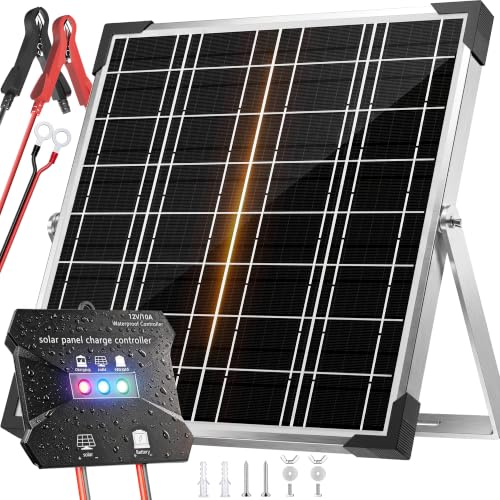 Best for a smart controller add-onVoltset 20W 12V Solar Panel Battery Charger Trickle Maintainer Kit | SView on Amazon
Our Top Picks
Quick Comparison
| Product | Best for | Key feature |
|---|---|---|
| Jackery Solar Generator 1000 v2 | Overall power and backup | 1024Wh LiFePO4 battery |
| ECO-WORTHY 200W Starter Kit | Complete off-grid setup | Includes inverter and battery |
| Solar Power Pack 280Wh | Light portable use | Pure sine wave output |
| 100W Monocrystalline Kit | Roof-mounted charging | 20A controller included |
| SUNER POWER 12W Pro | Keeping a battery topped up | MPPT charge controller |
| 20W 12V Solar Kit | Small battery maintenance | 8 protection functions |
| 20W Smart Charge Controller Kit | Marine and trailer use | Waterproof smart controller |
Jackery Solar Generator 1000 v2 and 200W Solar Panel, 1024Wh LiFePO4 Battery
Jackery Solar Generator 1000 v2 and 200W Solar Panel,1024Wh LiFePO4 Battery | 1500W (3000W Peak), 50-Min Fast Charge, 10ms UPS Solar Generator for Home Emergency, Camping & RV
Best for: Overall power and backup
This suits campers who run a small fridge, lights, a laptop and phone chargers and want a battery that handles a few days without sun.
Pros
- Large 1024Wh LiFePO4 battery capacity
- Fast recharge option from wall power
Cons
- Heavier than basic kits
ECO-WORTHY 200 Watt 12V Complete Solar Panel Starter Kit with Battery and Inverter
ECO-WORTHYwith Battery and Inverter: 2*100W Solar Panel + 30A Charge Controller + 100Ah Lithium Battery + 1100W Premium Solar Inverter 200 Watt 12V Complete Solar Panel Starter Kit for RV Off Grid
Best for: Complete off-grid setup
Good for first-time builders who want every component in one box rather than matching parts themselves.
Pros
- Includes 100Ah lithium battery, controller and inverter
- Two 100W panels for roof or ground mounting
Cons
- Total weight adds up on smaller roofs
Battery Solar Power Pack 280Wh with 60W Solar Panel
Portable Solar Generator 300W Portable Power Station with 60W Solar Panel | 110V Pure Sine Wave 280Wh Battery Solar Power Pack with USB QC3.0 DC AC Outlet for Camping Smart Device RV Van Outdoor-Orang
Best for: Portable power station use
A fit for weekend campers and van owners who want a plug-in unit they can move between the RV and a campsite table.
Pros
- Pure sine wave AC outlet for sensitive electronics
- Portable and simple to set up
Cons
- Smaller capacity than full kits
100W Monocrystalline Solar Panel Kit with 20A Charge Controller
Monocrystalline, with 20A Solar Charge Controller +16.4Ft Extension Cables for RV Marine Boat Off Grid System 100W Solar Panel Kit 12V Battery Maintainer
Best for: Roof-mounted charging
Suited to owners adding a permanent panel to an existing 12V battery bank.
Pros
- Monocrystalline panel with a 20A controller included
- Extension cables make routing easier
Cons
- Requires a separate battery
SUNER POWER Waterproof 12W Solar Battery Charger & Maintainer Pro
SUNER POWER Waterproof 12W 12V Solar Battery Charger & Maintainer Pro, Built-in Ultra-Smart MPPT Charge Controller, 12 Volt Solar Panel Trickle Charging Kits for Car Automotive Boat Marine RV Trailer
Best for: Keeping a battery topped up
Useful for RVs in storage where the battery needs a steady trickle to avoid draining.
Pros
- Built-in MPPT charge controller
- Waterproof design for outdoor mounting
Cons
- Too small to run appliances
20W 12V Solar Panel Kit MPPT Charge Controller IP68 Waterproof
Solar Powered Battery Charger Trickle Maintainer, 20W 12V Solar Panel Kits MPPT Charge Controller with 8 Protections Function IP68 Waterproof for RV Trailer Marine Car Motorcycle (1, Black)
Best for: Small battery maintenance
A practical option for owners who mainly need a battery kept charged between trips.
Pros
- Eight listed protection functions
- IP68 waterproof rating
Cons
- Low output for larger battery banks
Buying Guide
Panel Wattage and Your Daily Power Needs
Start by estimating how many watt-hours your RV uses in a typical day, including lights, the fridge, phone and laptop charging, and any fans. Panel wattage determines how quickly you can refill the battery under good sun, so a kit sized to your real daily use will serve you better than one that simply looks impressive on paper.
Keep in mind that panel output changes with sunlight, shade, angle and season. Plan for fewer usable hours in winter and in cloudy weather, and size your array with a margin.
Battery Capacity and Chemistry
Battery capacity, measured in watt-hours or amp-hours, tells you how long your devices can run after sunset or on cloudy days. Lithium iron phosphate (LiFePO4) batteries are widely favored in RV setups because they tolerate deep discharge cycles well and are generally lighter than lead-acid options.
Check whether the capacity listed is usable capacity or nominal capacity, since the two can differ. Matching the battery voltage to your RV system, usually 12V, is essential before you buy.
Charge Controller Type and Compatibility
The charge controller regulates the flow of power from the panels into the battery and protects against overcharging. MPPT controllers are generally more efficient than PWM controllers, especially when panel voltage is well above battery voltage, which is common in larger arrays.
Make sure the controller’s amperage rating and battery chemistry setting match your battery. A controller that supports the battery type you own will avoid undercharging or damage over time.
Waterproofing, Protections and Build Quality
RV equipment sees rain, road spray, temperature swings and vibration, so look for an IP rating and built-in protections such as overcharge, short-circuit, reverse polarity and over-temperature safeguards. Weatherproof connectors and sturdy mounting hardware matter as much as the electronics.
Read the included cable lengths as well. Extension cables can help you position panels for better sun exposure without running the battery in a cramped spot.
Kit Completeness and Installation Effort
Some kits include everything you need, such as panels, controller, cables and battery, while others cover only part of the system. A complete kit reduces guesswork, but make sure the components are compatible with one another and with your RV’s electrical layout.
If you are comfortable with basic wiring, a modular setup lets you upgrade pieces later. If not, a plug-and-play power station or a fully packaged starter kit may save time and reduce the chance of mistakes.
FAQ
How many solar panels do I need for my RV?
The right number depends on your daily watt-hour use and the amount of sun your location typically gets. Calculate your daily consumption, then add a buffer for cloudy days and seasonal changes. A starter kit with 100 to 200 watts of panels is often a reasonable place to begin for light use.
Can a solar panel battery kit run my RV air conditioner?
Most compact solar kits are not designed to run a roof air conditioner, which draws a large amount of power. These systems are better suited to lights, fans, phones, laptops, small appliances and battery maintenance. Heavier loads generally require a much larger battery bank and inverter.
Is a lithium battery better than lead-acid for RV solar?
Lithium batteries, particularly LiFePO4, typically offer more usable capacity, longer cycle life and lighter weight than lead-acid batteries. They usually cost more upfront, so the best choice depends on your budget and how often you camp off-grid. Make sure your charge controller supports lithium if you go that route.
Can I use a solar trickle charger to keep my RV battery topped off?
Yes, small solar trickle chargers and maintainers are designed to keep a battery charged while it sits in storage. They are useful for stored RVs, boats and trailers, but they do not provide enough power for regular camping loads. Think of them as maintenance tools rather than primary power sources.
Do I need a professional to install an RV solar system?
Many people install simple systems themselves, especially plug-and-play kits, but wiring into your RV’s electrical system can be complex. If you are unsure about wire gauge, fusing or grounding, consider having a qualified technician review or handle the installation. Safety should always come first.
Conclusion
For small campers and weekend trips that mainly need phone charging, lights and a fan, a compact trickle maintainer or a portable solar generator with a modest panel is an easy place to start. Those who camp off-grid for longer stretches or run more appliances should look at the larger starter kits and portable power stations with bigger battery capacity.
Whichever option you choose, match the panel wattage, battery capacity and charge controller to your actual daily needs and your RV’s electrical setup. Taking a few minutes to estimate your power use will help you pick a kit that performs well on the road.
Related reading
- Solar Panel to Charge RV Battery: A Step-by-Step Guide (2026)
- How Many Watt Solar Panel to Maintain RV Battery? A Practical Answer
- 6 Best Small Solar Panels for RV Battery Charging in 2026
- Top 5 Small 48V Solar Panels for Off-Grid and RV Use in 2026
About Claire Whitaker
Claire Whitaker is part of our editorial team and reviews and edits our small-scale solar guides, checking product details against manufacturer specifications and owner feedback.