 By Claire Whitaker
Updated November 2026
A shed solar power kit bundles panels, a charge controller, a battery and usually an inverter, so you can run lights, tools or small devices without trenching power out to the shed. We judged these seven options on how complete the kit is, how well the parts match each other, the battery capacity and inverter output listed by the manufacturer, and the kind of owner feedback that tends to come up about installation and performance.
Our top picks at a glance
- 1
 TOP CHOICEBest overallECO-WORTHY 200 Watt 12V Complete Solar Panel Starter Kit with Battery and InverterView on Amazon
- 2
 TOP CHOICEBest for lighting onlyECO-WORTHY 200 Watts 12 Volt/24 Volt Solar Panel KitView on Amazon
- 3
 TOP CHOICEBest for larger battery banksECO-WORTHY 200 Watt 12V Complete Kit with 100Ah Battery and 1100W InverterView on Amazon
- 4
 Best for expandable setupsRenogy 400Watt Premium Solar Kit with 40A MPPT Charge ControllerView on Amazon
- 5
 Best for shed backup powerECO-WORTHY 1280WH Complete Off-Grid Solar Panel Kit with 1000W InverterView on Amazon
- 6
 Best for whole-home backupWhole House System:10KW 120V/240V Split Phase Solar Inverter| 48V 314AView on Amazon
- 7
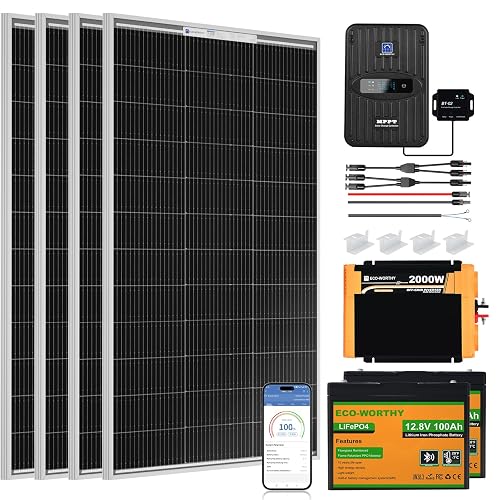 Best for mid-size loadsECO-WORTHY4 * 100W Solar Panel + 40A MPPT Controller + 2 * 12V 100Ah LView on Amazon
Our Top Picks
Quick Comparison
| Product | Best for | Key feature |
|---|---|---|
| ECO-WORTHY 200W Starter Kit with Battery and Inverter | Overall shed use | Battery and inverter included |
| ECO-WORTHY 200W 12V/24V Panel Kit | Lighting only | Dual 12V/24V compatibility |
| ECO-WORTHY 200W Kit with 100Ah Battery | Larger battery banks | 100Ah lithium battery |
| Renogy 400W Premium Solar Kit | Expandable setups | 40A MPPT controller |
| ECO-WORTHY 1280WH Off-Grid Kit | Shed backup power | 1000W pure sine inverter |
| ECO-WORTHY 10KW Whole House System | Whole-home backup | 16kWh storage |
| ECO-WORTHY 1.6KWH Complete Kit 400W | Mid-size loads | 2000W inverter |
ECO-WORTHY 200 Watt 12V Complete Solar Panel Starter Kit with Battery and Inverter
with Battery and Inverter: 200W Solar Panels+30A Charge Controller+50Ah Lithium Battery+600W Solar Power Inverter ECO-WORTHY 200 Watt 12V Complete Solar Panel Starter Kit for RV Off Grid
Best for: Overall shed use with minimal sourcing
This kit suits someone who wants every component in one box and plans to power LED lights, fans and phone chargers.
Pros
- Battery and inverter included
- Matched components reduce guesswork
Cons
- Capacity may feel limited for power tools
ECO-WORTHY 200 Watts 12 Volt/24 Volt Solar Panel Kit
ECO-WORTHY 200 Watts 12 Volt/24 Volt Solar Panel Kit with High Efficiency Monocrystalline Solar Panel and 30A PWM Charge Controller for RV, Camper, Vehicle, Caravan and Other Off Grid Applications
Best for: Lighting only
Owners running a few low-draw LED fixtures who already have a battery or prefer to buy one separately will find this useful.
Pros
- Works with 12V or 24V systems
- Includes a PWM charge controller
Cons
- No battery or inverter included
ECO-WORTHY 200 Watt 12V Complete Kit with 100Ah Battery and 1100W Inverter
ECO-WORTHYwith Battery and Inverter: 2*100W Solar Panel + 30A Charge Controller + 100Ah Lithium Battery + 1100W Premium Solar Inverter 200 Watt 12V Complete Solar Panel Starter Kit for RV Off Grid
Best for: Larger battery banks
A good match for a workshop shed where refrigerators, radios and occasional power tools need more stored energy.
Pros
- 100Ah lithium battery adds runtime
- Higher inverter output than starter kits
Cons
- Heavier to move and position
Renogy 400Watt Premium Solar Kit with 40A MPPT Charge Controller
4x100W monocrystalline panels. 40A MPPT charge controller. Includes Bluetooth module, Z-brackets, cables, adaptor kit. Renogy 400Watt Premium Solar Kit with 40A MPPT Charge Controller
Best for: Expandable setups
Suited to owners who want an MPPT controller now and plan to add panels or batteries as the shed’s needs grow.
Pros
- MPPT controller with Bluetooth monitoring
- Includes mounting brackets and cables
Cons
- Battery and inverter must be bought separately
ECO-WORTHY 1280WH Complete Off-Grid Solar Panel Kit with 1000W Inverter
1280WH Complete Off-Grid Solar Panel Kit with 1000W Pure Sine Wave Inverter, 20A MPPT Controller & 100Ah 12.8V Battery, 2×120W Monocrystalline Solar Panels for RV Boat Cabin Shed Home Backup
Best for: Shed backup power
Fits a shed that doubles as a workspace or storage area needing steady backup for lights, a freezer or small appliances.
Pros
- 1000W pure sine wave inverter
- 20A MPPT controller with 100Ah battery
Cons
- Panel count is modest for heavy daily loads
Buying Guide
Match the Kit to Your Shed Load
Start by listing what you plan to run in the shed, such as LED lights, a small fan, a power tool charger or a workbench radio. A kit with a smaller battery and inverter suits light, occasional use, while a larger battery and higher inverter output are better if you want to run heavier tools or keep devices on for longer stretches.
Check How Complete the Kit Is
Some bundles include only panels and a controller, while others add a battery, inverter, mounting brackets and cables. A more complete kit can save time and reduce the risk of mismatched parts, but make sure you understand what is actually included before comparing prices in your own search.
Consider Charge Controller Type
Kits use either PWM or MPPT charge controllers. MPPT controllers generally handle variable sunlight and higher panel voltages more efficiently, which can matter on cloudy days or in larger systems, while PWM controllers are simpler and often adequate for smaller setups.
Think About Battery Type and Expansion
Lithium batteries are lighter and tend to hold up well over many charge cycles, though they cost more up front. If you expect your needs to grow, look for a kit that supports adding panels or batteries later, or that uses a voltage platform you can build on.
Plan the Mounting and Installation
Your shed roof’s direction, shade from trees and available space will shape how much sun the panels receive. Confirm that the included brackets fit your roof type, and plan for cable routing and a safe location for the battery, since installation details often determine how well a system performs day to day.
FAQ
Can a shed solar power kit run a full electrical panel?
Most shed kits are designed for lighting, small appliances and tools rather than a whole building. Larger systems can power more, but you should match the inverter and battery capacity to the specific devices you plan to run.
Do I need a permit to install a shed solar kit?
Requirements vary by location, and small off-grid systems are sometimes treated differently from grid-tied installations. Check with your local building department before you install, especially if the system is permanently mounted.
How long will the battery last during a power outage?
Runtime depends on battery capacity, inverter efficiency and how much power your devices draw. Estimating your daily watt-hour use before buying is the most reliable way to judge how long a kit will keep your shed running.
Can I install the kit myself?
Many people with basic electrical and roof-work skills install small kits on their own, following the manufacturer instructions carefully. If you are unsure about wiring, roof safety or grounding, consider hiring a licensed electrician or solar installer.
Do solar panels work on cloudy days?
Panels still produce some power in cloudy conditions, though output drops compared with bright sun. Adding a bit of extra panel capacity or choosing a more efficient controller can help the system keep up during overcast weather.
Conclusion
If you only need to run a few shed lights and occasional small devices, a smaller starter kit with a modest battery and inverter is the most practical choice. Owners with heavier tools or more frequent use should look at the larger battery and inverter options that offer more runtime and headroom.
Shoppers who want a simple, ready-to-mount package with the fewest decisions should favor the more complete kits, while those planning to expand later may prefer a system with an MPPT controller and room to grow. Matching the kit to your real daily power use is the best way to end up with a setup you will be happy with.
Related reading
- Solar Power Shed System: 5 Best Kits Compared for 2026
- Solar Power Set Up for Shed: Top 3 Kits Compared for 2026
- 4 Best Solar Powers for Garden Shed Kits Compared for 2026
- Top 6 Solar Power Shed Heater Picks for Every Need (2026)
About Claire Whitaker
Claire Whitaker is part of our editorial team and reviews and edits our small-scale solar guides, checking product details against manufacturer specifications and owner feedback.


