By Owen Palmer
Updated November 2026
Choosing a solar panel for a small cabin comes down to a few practical questions: how many watts you actually use each day, whether you need AC power for appliances, how much room you have for mounting, and how much battery storage you want to add. This list focuses on complete kits and panel packages sold on Amazon US that are commonly used for cabins, sheds, RVs and small off-grid homes. We looked at manufacturer specifications, brand track record, and the patterns owners tend to describe in their feedback, including charge controller type, battery chemistry, inverter output and whether the kit is expandable.
Our top picks at a glance
- 1
 TOP CHOICEBest overall1280WH Complete Off-Grid Solar Panel Kit with 1000W Pure Sine Wave InvView on Amazon
- 2
 TOP CHOICEBest for small budgetsECO-WORTHY 200 Watts 12 Volt/24 Volt Solar Panel Kit with High EfficieView on Amazon
- 3
 TOP CHOICEBest for a starter setup with battery and inverterwith Battery and Inverter: 200W Solar Panels+30A Charge Controller+50AView on Amazon
- 4
 Best for tight roof or wall spaceHQST 400W Solar Panel, 2 * 200W, N-Type, 16BB, up to 25.4% Efficiency, IP65View on Amazon
- 5
 Best for expanding over time4 * 100W Solar Panel + 40A MPPT Controller + 2 * 12V 100Ah Lithium BatView on Amazon
- 6
 Best single panel for a DIY build200W Solar Panel for 12V/24V Battery Systems, IP67 PV Module for RV MaView on Amazon
Our Top Picks
Quick Comparison
| Product | Best for | Key feature |
|---|---|---|
| 1280WH Complete Off-Grid Solar Panel Kit | Full cabin backup power | 1000W pure sine wave inverter and 100Ah battery included |
| ECO-WORTHY 200W 12V/24V Solar Panel Kit | Small budgets and 12V or 24V systems | 30A PWM charge controller |
| ECO-WORTHY 200W 12V Starter Kit | First-time off-grid setups | Includes 50Ah lithium battery and 600W inverter |
| HQST 400W Solar Panel | Limited roof or wall space | N-type cells, IP65 rating |
| ECO-WORTHY 1.6KWH Complete Solar Panel Kit | Larger cabins that may grow | 2000W inverter and Bluetooth monitoring module |
| Renogy Solar Panels 200 Watt | DIY builders who want their own components | N-type panel, IP67 rating, 16BB cell layout |
1280WH Complete Off-Grid Solar Panel Kit with 1000W Pure Sine Wave Inverter, 20A MPPT Controller & 100Ah 12.8V Battery
1280WH Complete Off-Grid Solar Panel Kit with 1000W Pure Sine Wave Inverter, 20A MPPT Controller & 100Ah 12.8V Battery, 2×120W Monocrystalline Solar Panels for RV Boat Cabin Shed Home Backup
Best for: Full cabin backup power for lights, a refrigerator and small electronics
This is a bundled system aimed at owners who want one purchase that covers panels, controller, battery and inverter. It suits a cabin with modest daily loads that wants power without designing components separately.
Key specs
- Two 120W monocrystalline solar panels
- 20A MPPT charge controller
- 100Ah 12.8V battery (about 1280Wh stored)
- 1000W pure sine wave inverter
Pros
- Pure sine wave output is suitable for sensitive electronics
- MPPT controller generally harvests more energy than PWM in variable light
- Everything is matched, which simplifies setup
Cons
- Total panel output is modest for heavy winter loads
- Bundled components limit upgrades to individual parts
Bottom line: A good pick for someone who wants a complete, matched system for a small cabin with moderate daily use.
ECO-WORTHY 200 Watts 12 Volt/24 Volt Solar Panel Kit with High Efficiency Monocrystalline Solar Panel and 30A PWM Charge Controller
ECO-WORTHY 200 Watts 12 Volt/24 Volt Solar Panel Kit with High Efficiency Monocrystalline Solar Panel and 30A PWM Charge Controller for RV, Camper, Vehicle, Caravan and Other Off Grid Applications
Best for: Small budgets and 12V or 24V battery systems
This kit fits owners who already have a battery bank or are building a simple 12V system for lights, fans and phone charging in a small cabin or shed.
Key specs
- 200W monocrystalline panel output
- 30A PWM charge controller
- Compatible with 12V and 24V systems
Pros
- Simple, low-complexity setup
- Works with both 12V and 24V battery banks
- Good fit for lighter loads
Cons
- PWM controller is less efficient than MPPT in cold or cloudy conditions
- No battery or inverter included
Bottom line: Best for owners who want a straightforward panel and controller and already have or plan to buy their own battery.
with Battery and Inverter: 200W Solar Panels + 30A Charge Controller + 50Ah Lithium Battery + 600W Solar Power Inverter ECO-WORTHY 200 Watt 12V Complete Solar Panel Starter Kit
with Battery and Inverter: 200W Solar Panels+30A Charge Controller+50Ah Lithium Battery+600W Solar Power Inverter ECO-WORTHY 200 Watt 12V Complete Solar Panel Starter Kit for RV Off Grid
Best for: First-time off-grid setups that need battery and inverter in one box
Suited to a beginner who wants to start small, learn how the system behaves, and expand later with extra panels or batteries.
Key specs
- 200W solar panel array
- 30A charge controller
- 50Ah lithium battery
- 600W solar power inverter
Pros
- Includes battery and inverter, reducing shopping steps
- Lithium battery is lighter and handles deeper cycles than lead-acid
- Good entry point for a small cabin
Cons
- 50Ah storage is limited for heavy evening use
- 600W inverter may not run high-draw appliances
Bottom line: A sensible starter kit for a weekend cabin or shed with light, planned loads.
HQST 400W Solar Panel, 2 * 200W, N-Type, 16BB, up to 25.4% Efficiency, IP65
Compact 46.3*30.1*1.2 inch, Grade A+ Cells, 30-Year Life, Low-Light Performance, for RV, Trailer, Marine, Rooftop, Off Grid HQST 400W Solar Panel, 2 * 200W, N-Type, 16BB, up to 25.4% Efficiency, IP65
Best for: Limited roof or wall space where efficiency per square foot matters
This is a panel-only option for owners who already have controllers and batteries and need to squeeze more output out of a small mounting area.
Key specs
- 400W total (two 200W panels)
- N-type cells, 16BB layout
- Rated up to 25.4% efficiency per listing
- IP65 rating
Pros
- High output for its footprint
- N-type cells generally perform better in heat and low light
- IP65 rating suits outdoor mounting
Cons
- Panel only, so controller and battery are extra purchases
- Premium-level components can mean a higher buy-in than basic panels
Bottom line: Best for cabin owners with a compact roof and an existing or planned battery and controller setup.
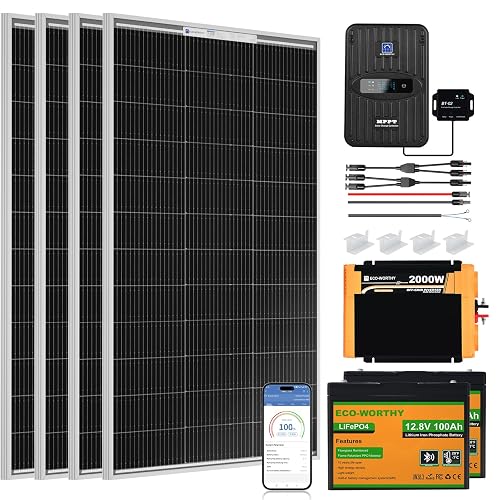
4 * 100W Solar Panel + 40A MPPT Controller + 2 * 12V 100Ah Lithium Battery + Upgraded 2000W Power Inverter + Bluetooth Module ECO-WORTHY 1.6KWH Complete Solar Panel Kit 400W 12V
4 * 100W Solar Panel + 40A MPPT Controller + 2 * 12V 100Ah Lithium Battery + Upgraded 2000W Power Inverter + Bluetooth Module ECO-WORTHY 1.6KWH Complete Solar Panel Kit 400W 12V for RV Off Grid
Best for: Larger cabins that expect to add loads or panels later
This kit suits owners who want more stored energy and inverter headroom than a starter kit, and who like having a monitoring module for battery status.
Key specs
- Four 100W panels (400W total)
- 40A MPPT charge controller
- Two 12V 100Ah lithium batteries (about 1.6kWh)
- 2000W power inverter
Pros
- Substantial storage for a small cabin
- MPPT controller and Bluetooth monitoring
- 2000W inverter handles more appliances
Cons
- Heavier and needs more mounting space
- Higher total system size means more wiring planning
Bottom line: A good fit for a cabin with regular daily use that may grow over time.
200W Solar Panel for 12V/24V Battery Systems, IP67 PV Module for RV Marine Rooftop Farm Trailer Cabin Home Off-Grid Renogy Solar Panels 200 Watt
200W Solar Panel for 12V/24V Battery Systems, IP67 PV Module for RV Marine Rooftop Farm Trailer Cabin Home Off-Grid Renogy Solar Panels 200 Watt, N-Type Solar Panel 25% High-Efficiency 16BB
Best for: DIY builders who want to choose their own controller, battery and inverter
A single panel that works as a building block. It suits owners who prefer to design the system and buy matched components separately.
Key specs
- 200W panel for 12V or 24V battery systems
- N-type cells, 16BB layout
- IP67 rating
Pros
- Flexible: mix with other panels and controllers
- IP67 rating suits harsh outdoor exposure
- N-type cells perform well in heat
Cons
- Requires separate controller, battery and wiring
- Not a plug-and-play option for beginners
Bottom line: Best for experienced DIY owners building a custom small cabin system.
Buying Guide
System Size and Daily Energy Use
Start by listing the devices you plan to run and their wattage and hours per day. Multiply to get watt-hours per day, then size battery storage to cover at least one cloudy day. Panel wattage should cover your daily total after accounting for losses, which often run around 20 to 30 percent in real installations.
Good picks for this: 1280WH Complete Off-Grid Solar Panel Kit, ECO-WORTHY 1.6KWH Complete Solar Panel Kit
Charge Controller Type
MPPT controllers generally extract more power from panels than PWM controllers, especially when panel voltage is higher than battery voltage or in cold, low-light conditions. PWM controllers are simpler and less expensive, which can be reasonable for smaller arrays.
Good picks for this: ECO-WORTHY 200 Watts 12 Volt/24 Volt Solar Panel Kit, 1280WH Complete Off-Grid Solar Panel Kit
Battery Chemistry and Capacity
Lithium iron phosphate batteries are lighter and tolerate deeper discharge than most lead-acid batteries. Check usable capacity rather than nominal capacity, and confirm the battery voltage matches your controller and inverter.
Good picks for this: ECO-WORTHY 200 Watt 12V Complete Solar Panel Starter Kit, ECO-WORTHY 1.6KWH Complete Solar Panel Kit
Inverter Output and Waveform
Add up the running watts of everything you plan to run at the same time, and check surge ratings for motors such as refrigerators. Pure sine wave output is generally preferred for sensitive electronics and some motor loads.
Good picks for this: 1280WH Complete Off-Grid Solar Panel Kit, ECO-WORTHY 1.6KWH Complete Solar Panel Kit
Panel Size, Efficiency and Mounting Space
Measure your roof, wall or ground area before buying. Higher-efficiency panels produce more watts per square foot, which matters on a small roof. Check dimensions and weight against your mounting hardware and structure.
Good picks for this: HQST 400W Solar Panel, Renogy Solar Panels 200 Watt
Weather Resistance and Durability
Look for IP ratings and frame quality. IP65 and IP67 ratings describe resistance to dust and water ingress as defined by the IEC standard. Outdoor cables should be UV-rated and connectors should be weather-sealed.
Good picks for this: HQST 400W Solar Panel, Renogy Solar Panels 200 Watt
Expandability
If you expect your needs to grow, choose a system whose controller, inverter and battery can accept additional panels or batteries. Check the maximum input voltage and current of the controller before adding panels.
Good picks for this: ECO-WORTHY 1.6KWH Complete Solar Panel Kit, Renogy Solar Panels 200 Watt
FAQ
How many solar panels does a small cabin need?
It depends on daily energy use. A cabin running lights, a small fridge and charging devices may need roughly 400 to 800 watts of panels, plus enough battery storage for a cloudy day. Calculate your daily watt-hours before deciding.
Is a 200W panel enough for a cabin?
A single 200W panel can run lights and small electronics in favorable sun, but it may not keep up with refrigerators or power tools. Two or more panels are common for year-round cabin use.
What is the difference between MPPT and PWM controllers?
MPPT controllers adjust voltage to pull more power from panels, often gaining noticeable output in cold or low-light conditions. PWM controllers are simpler and work well in smaller, steady setups.
Should I choose lithium or lead-acid batteries?
Lithium batteries are lighter, handle deeper discharge and generally last longer per cycle, but cost more upfront. Lead-acid batteries are familiar and lower in initial purchase, but need more maintenance and usable capacity is lower.
Do I need a professional to install a cabin solar system?
Many owners install small systems themselves, but wiring and battery connections involve shock, fire and electrical code risks. Consult a licensed electrician, especially for grid-tied or permanently wired systems.
Can I run a microwave or space heater on a small solar system?
Usually not. Microwaves and resistive heaters draw high power for long periods and can exceed the capacity of small inverters and batteries. Consider propane or wood for heating and use solar for lighter loads.
Conclusion
For most small cabins, a complete kit with matched controller, battery and inverter is the simplest route. The 1280WH Complete Off-Grid Solar Panel Kit suits owners wanting a balanced bundle, while the ECO-WORTHY 200W Starter Kit fits first-time users. Choose the ECO-WORTHY 1.6KWH kit for more storage and room to grow, the HQST 400W panel where roof space is tight, and the Renogy 200W panel for custom DIY builds. Match your pick to your daily watt-hours and mounting space, and confirm electrical details with a professional when in doubt.
Sources
- Guidance on how solar photovoltaic systems work and how to size them (energy.gov)
- Research on solar resource data and system performance for home and off-grid use (nrel.gov)
- International standards for photovoltaic modules and ingress protection ratings
Related reading
- Solar Panel Kits for Small Cabin: A Step-by-Step Buyer's Guide
- What Are Small Solar Panel Systems? Parts, Uses and Picks
- Top 7 Small Solar Power Panel Picks for Every Need (2026)
- Top 5 Ring Small Solar Panel USB C Picks for Ring Cameras
- Start Small With Solar: Portable Panels and Power Stations
- Solar Panel System for Small House: A Step-by-Step Guide for Beginners

About Owen Palmer
Owen has been writing about small-scale solar for this site, with an eye on clear explanations, honest trade-offs and options for different needs and budgets.