By Weston Dawson
If you want to install solar on RV roofs, the hardest part is rarely the panel itself. It is the mounting hardware, the way cables pass through the roof, the kit that ties everything together, and the panel type that fits your roof shape. This guide covers seven products that address those needs, chosen by comparing listed specifications, brand reputation and the patterns owners tend to report. Our selection criteria were material and corrosion resistance, compatibility with common RV and van roofs, how clearly the listing states its specs, and whether the product fills a real gap in a typical installation. Nothing here reflects personal testing; we are summarizing published information and general owner feedback.
Our Top Picks
Quick Comparison
| Product | Best for | Key feature |
|---|---|---|
| Solar Panel Bracket For Thickness 30/35mm Panel (aluminum rail and clamp kit) | Metal and tin roofs with rail-style mounting | Corrosion-free aluminum rail and clamps |
| BougeRV Solar Weatherproof Double Cable Entry Gland | Running two cables through the roof cleanly | Double entry gland for 14 AWG to 10 AWG cables |
| Renogy Solar Panel Mounting Z Brackets | Rigid panels on flat or low-slope roofs | Lightweight aluminum Z brackets, sold as a set of four |
| BougeRV Flexible Solar Panel Waterproof Butyl Rubber Tape | Sealing and bonding flexible panels to curved roofs | Butyl tape roll, 3.98 in by 32.8 ft |
| ECO-WORTHY 200W 12V/24V Solar Panel Kit | A complete starter kit for a first RV build | Panels plus 30A PWM charge controller |
| Drill-Free Solar Panel Mounting Brackets ABS Corner Bracket Kit 7PCS | Roofs where you want to avoid drilling | Drill-free ABS corner brackets |
| DOKIO 100W Flexible Solar Panel, 18V ETFE | Curved or low-profile roofs with weight limits | Lightweight semi-flexible ETFE panel with MC4 leads |
Solar Panel Bracket For Thickness 30/35mm Panel, Corrosion-Free Aluminium Solar Rail & Clamps
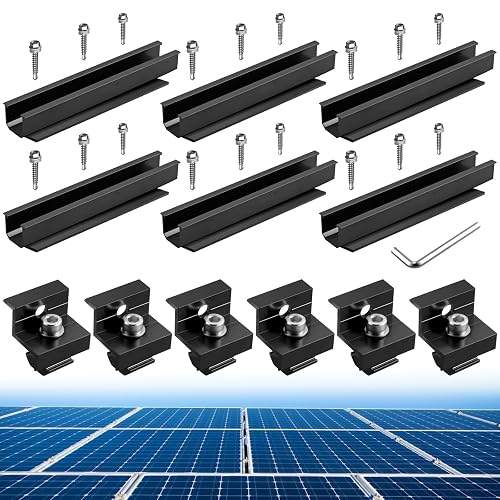
Solar Panel Bracket For Thickness 30/35mm Panel, Corrosion-Free, For Metal Roof, Tin Roof, Flat Roof, Sheet Roof, RV, Black Solar Panel Roof Mounting Kit, 7.87" Aluminium Solar Rail & Clamps
Who it is for: Owners with a metal, tin or sheet roof who want a rail-based mount that clamps onto panel frames without bolting through the roof membrane in every spot.
Key specs
- Designed for 30 mm and 35 mm panel frame thickness, according to the listing name
- Aluminum construction with a corrosion-free finish
- Rail and clamp kit for metal, tin, flat and sheet roofs
Pros
- Clamp-style mounting suits panel frames without custom drilling
- Aluminum resists rust on exposed metal roofs
- Matches common panel frame sizes listed in the title
Cons
- Only useful if your panel frame falls within the stated thickness range
- Clamp hardware must be torqued evenly, or the panel can shift
BougeRV Solar Weatherproof Double Cable Entry Gland

BougeRV Solar Weatherproof Double Cable Entry Gland, Cable Through RV roof Solar Junction Box abs Entry housing for 14AWG to 10AWG Solar Cables for Solar Project on RV, Campervan, Boat, Van(Gray)
Who it is for: Anyone running solar cables through the roof of a van, camper or boat and wanting a sealed, purpose-built entry point instead of an improvised hole.
Key specs
- Double cable entry housing, according to the listing name
- Listed for 14 AWG to 10 AWG solar cables
- ABS housing with a weatherproof gland design
Pros
- Two entries let you route positive and negative leads together
- Sized for common solar cable gauges
- Keeps the roof penetration tidy and sealed
Cons
- You still need to seal the mounting surface with butyl or sealant
- Gland sizing must match your cable diameter exactly
Renogy Solar Panel Mounting Z Brackets

Renogy Solar Panel Mounting Z Brackets Lightweight Aluminum Corrosion-Free Construction for RVs, Trailers, Boats, Yachts, Wall and Other Off Gird Roof Installation, one set of 4 Units,Gray
Who it is for: Owners mounting rigid panels on RV, trailer or boat roofs who want a set of aluminum brackets from a widely known solar brand.
Key specs
- Sold as one set of four Z brackets, according to the listing
- Lightweight aluminum, corrosion-resistant construction
- Intended for RVs, trailers, boats and off-grid roof installations
Pros
- Four-bracket set covers a standard panel’s mounting points
- Aluminum keeps weight low on lightweight roofs
- Brand recognition makes replacement parts easier to find
Cons
- Z brackets usually require drilling and sealing the roof
- Fit depends on matching your panel frame and roof rails
BougeRV Flexible Solar Panel Waterproof Butyl Rubber Tape

for Flexible Solar Panel Yuma CIGS Thin-Film Arch BougeRV Flexible Solar Panel Waterproof Butyl Rubber Tape 3.98'' x 32.8 Ft
Who it is for: Owners bonding a flexible or thin-film panel to a curved fiberglass or metal roof, where bolts are not an option.
Key specs
- Butyl rubber waterproof tape, 3.98 in by 32.8 ft, according to the listing
- Designed for flexible solar panel bonding
- Pairs with BougeRV flexible panel listings in this group
Pros
- Long roll covers a full multi-panel install
- Butyl adhesive stays flexible in temperature swings
- No roof penetrations required for bonding
Cons
- Adhesive bonds are hard to reverse without damaging the panel
- Surface must be cleaned and dry for the seal to hold
ECO-WORTHY 200 Watts 12 Volt/24 Volt Solar Panel Kit with 30A PWM Charge Controller

ECO-WORTHY 200 Watts 12 Volt/24 Volt Solar Panel Kit with High Efficiency Monocrystalline Solar Panel and 30A PWM Charge Controller for RV, Camper, Vehicle, Caravan and Other Off Grid Applications
Who it is for: First-time RV owners who want panels, a charge controller and the basic wiring in one package rather than sourcing each part separately.
Key specs
- 200 W total, according to the listing name
- 12 V or 24 V system compatibility, per the listing
- 30A PWM charge controller included
Pros
- Panels and controller are matched in one order
- Monocrystalline panels are a common, efficient choice
- Suits a 12 V RV battery bank out of the box
Cons
- PWM controllers give less charge than MPPT in cold or low-light conditions
- Mounting hardware is not the focus of the kit, so budget for brackets separately
Drill-Free Solar Panel Mounting Brackets ABS Corner Bracket Kit 7PCS

Drill-Free Widely Used on Roofs of RV, Caravans, Vehicles, Camper Vans, Sheds, Garages, Deck of Boats, White Solar Panel Mounting Brackets ABS Corner Bracket Kit 7PCS
Who it is for: Owners who want to mount panels on a roof without drilling, typically for temporary setups or roofs where penetrations are a concern.
Key specs
- Seven-piece ABS corner bracket kit, according to the listing name
- Drill-free attachment method, per the listing
- White finish, suited to RVs, vans and sheds
Pros
- No roof penetrations if the mount holds
- Lightweight ABS keeps added load low
- Works on several roof types listed in the title
Cons
- Adhesive or clip-style mounts may not handle highway wind loads as well as bolted mounts
- Owners should check the manufacturer’s load rating before relying on it on a moving vehicle
DOKIO 100W Flexible Solar Panel, 18V ETFE for 12V RV and Marine Systems

Lightweight semi-flexible ETFE panel with MC4 leads; for RV, boat, van, trailer and other off-grid installations DOKIO 100W Flexible Solar Panel, 18V ETFE, for 12V RV and Marine Systems
Who it is for: Van and RV owners with curved or weight-limited roofs who want a thin, semi-flexible panel with a 100 W rating.
Key specs
- 100 W rating, according to the listing name
- 18 V nominal output, per the listing
- ETFE front surface with MC4 leads, as stated in the listing
Pros
- Lightweight construction suits low-profile roofs
- ETFE surface is durable and UV-resistant in general terms
- MC4 leads make connection to standard controllers straightforward
Cons
- Flexible panels typically run hotter and may produce less than rigid panels of the same rating
- Must be bonded or secured carefully; adhesion depends on the roof surface
Buying Guide
Before you buy any component to install solar on RV roofs, sketch your roof layout and note your roof material, available mounting area and any existing vents, racks or antennas. That single step narrows the field more than any spec sheet.
Selection Criteria
- Roof material: Metal and fiberglass roofs call for different mounts, sealants and fasteners.
- Weight: Rigid panels plus mounts add load. Check your roof and vehicle weight limits.
- Corrosion resistance: Aluminum and ABS parts are common choices for exposed roof hardware.
- Compatibility: Panel frame thickness, cable gauge and connector type must match.
Important Features
- Sealed roof penetrations with proper butyl or sealant
- Cable glands sized for your wire gauge
- Charge controller type (PWM for simple systems, MPPT for better charge in variable conditions)
Specs to Check
- Panel wattage and nominal voltage
- Frame thickness for clamp-style mounts
- Cable AWG rating for entry glands
- Manufacturer load or wind rating for drill-free mounts
Choosing by Need
If you want the fewest roof penetrations, start with flexible panels and butyl tape or drill-free brackets. If you want the most durable long-term mount, use aluminum rails or Z brackets with proper sealing. If you are new and want everything matched, a kit with a controller is the simplest starting point.
Things to Watch Out For
- Under-sealed holes are the most common cause of roof leaks.
- Mixing incompatible brackets and panel frames can damage the panel.
- Adhesives and drill-free mounts can fail under highway vibration and wind.
Because roof penetrations and electrical work affect safety and warranties, consider consulting a qualified RV technician or electrician before finalizing your install.
FAQ
Can I install solar on RV roofs without drilling?
Yes, some owners use butyl tape or drill-free corner brackets. Check the manufacturer’s load rating, since adhesive mounts vary in how well they handle wind and vibration while driving.
What roof type is easiest for an RV solar install?
Flat or low-slope metal roofs are often easiest because rail and clamp mounts attach cleanly. Curved fiberglass roofs usually suit flexible panels bonded with butyl tape.
Do I need a charge controller?
Yes. A controller regulates charge to your battery. PWM controllers are simpler and common in kits; MPPT controllers typically extract more energy in variable light.
What cable size should I use for RV solar?
Cable gauge depends on current and run length. Many small RV systems use 10 AWG to 14 AWG wire, but confirm sizing with your panel and controller specifications.
How do I seal a roof hole for solar cables?
Use a cable entry gland designed for the purpose and seal the base with butyl or a compatible RV sealant. Clean and dry the surface first, and re-check seals periodically.
Is a flexible panel as good as a rigid one?
Flexible panels are lighter and conform to curves, but they often run hotter and can produce less per square foot than rigid panels. The right choice depends on your roof and weight limits.
Should I hire someone for the install?
If you are unsure about roof penetrations, wiring or battery sizing, consult a qualified RV technician or licensed electrician. Mistakes in these areas can cause leaks, fire risk or warranty problems.
Conclusion
To install solar on RV roofs successfully, match your hardware to your roof material and weight limits first. Choose aluminum rail or Z brackets with proper sealing for rigid panels on metal or flat roofs. Pick the BougeRV entry gland and butyl tape for clean cable routing and bonding. The ECO-WORTHY kit suits a first build with a controller included, while the DOKIO flexible panel fits curved, weight-sensitive roofs. Drill-free kits work best where penetrations are a concern, provided you verify their load ratings. Start with your roof, plan the layout, and build from there.
Related reading
- Installing Solar Panels RV: 6 Best Picks and Buyer's Guide (2026)
- 8 Best DIY Solar Panels for RV Use in 2026
- Top 8 Solar Lights for Balcony Options for Small Outdoor Spaces
- Top 7 Balcony Solar Systems with Battery Options for Apartments

About Weston Dawson
Weston puts together our small-scale solar guides, digging through specifications, manufacturer details and owner reviews so you don't have to.