 By Miles Sinclair
Updated November 2026
Choosing a small solar panel system for shed use comes down to how much power you need, whether the shed is wired to a home, and how much setup work you want to take on. The three kits below were compared using manufacturer specifications, product listings and common owner feedback patterns. Each one is sized for a different job, from a few shed lights to a full off-grid workshop.
Our top picks at a glance
- 1
 TOP CHOICEBest overallWhole House System 10KW Off-Grid KitView on Amazon
- 2
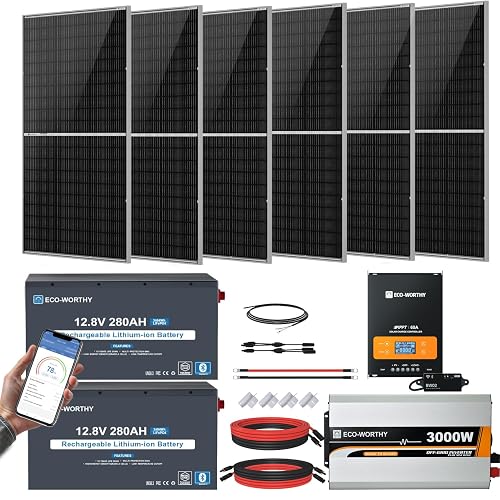 Best for a mid-size workshopECO-WORTHY 1200W 24V Lithium Battery Solar SystemView on Amazon
- 3
 Best for high-draw toolsECO-WORTHY 5KW Off Grid Solar System Complete KitView on Amazon
Our Top Picks
Quick Comparison
| Product | Best for | Key feature |
|---|---|---|
| Whole House System 10KW Off-Grid Kit | Large, whole-building loads | 16kWh battery storage |
| ECO-WORTHY 1200W 24V Solar System | Mid-size shed workshop | 6 panels, 60A controller |
| ECO-WORTHY 5KW Off Grid Kit | Power tools and motors | 12 panels, 5000W inverter |
Whole House System 10KW Off-Grid Kit
Whole House System:10KW 120V/240V Split Phase Solar Inverter| 48V 314Ah 16kWh High Capacity Energy Storage| 2950W Solar Panel ECO WORTHY 10000W Output Complete Off-Grid Solar Panel Kit for Home
Best for: Sheds that need to run heavy loads or serve as a full off-grid building.
This kit suits owners who want a shed powered as if it were a small home, with a split-phase inverter and a large battery bank. It is more system than most sheds need, so it fits best where the shed is a real workspace.
Pros
- Large 16kWh battery capacity for extended runtime
- Split-phase 120V/240V output for bigger appliances
Cons
- Installation is more involved than smaller kits
ECO-WORTHY 1200W 24V Lithium Battery Solar System
6pcs 195W Solar Panels+2Pcs 12.8V 280Ah Lithium Battery+60A MPPT Charge Controller+3000W Pure Sine Wave Inverter [Ultra] ECO-WORTHY 1200W 24V 4.68KWH Lithium Battery Solar System Off Grid
Best for: A mid-size shed workshop with lights, chargers and small power tools.
This is a practical middle option for a shed that needs reliable daytime and battery-backed power without a whole-house setup. It suits owners who want a manageable system they can expand later.
Pros
- Includes a pure sine wave inverter for sensitive electronics
- Lithium batteries are lighter than lead-acid alternatives
Cons
- Runtime on heavy tools will be limited
ECO-WORTHY 5KW Off Grid Solar System Complete Kit
Off Grid Solar Panle Kit with Battery & Inverter:12x195W Panels, 48V 5000W Solar Inverter, 48V 100AH Cubix LiFePO4 Battery ECO-WORTHY 5KW Off Grid Solar System Complete Kit 2340W
Best for: Sheds running power tools, compressors or motors.
This kit targets shed owners whose equipment draws more current at startup. The 5000W inverter and 12-panel array give more headroom than the smaller kits.
Pros
- 5000W inverter handles higher startup loads
- 12 panels provide more daily energy input
Cons
- Needs a larger roof or ground area for the panels
Buying Guide
Estimate your daily energy use
Add up the watt-hours each device uses per day, such as lights, chargers and tools. This total tells you how big the battery and panel array need to be.
Check your inverter output
The inverter must handle the highest wattage you will run at once. Tools with motors often need several times their rated wattage at startup.
Plan the mounting location
Panels need unshaded southern exposure in most US locations. Confirm your roof can carry the weight and that the wiring route is short.
Consider battery type
Lithium batteries generally offer longer cycle life and lighter weight than lead-acid. Compare the usable capacity, not just the nominal rating.
Good picks for this: ECO-WORTHY 1200W 24V Lithium Battery Solar System and ECO-WORTHY 5KW Off Grid Solar System Complete Kit
FAQ
Can a small solar panel system run a shed workshop?
Yes, a mid-size kit can power lights, chargers and small tools. Heavier equipment usually needs a larger inverter and battery bank.
Do I need a permit for a shed solar system?
Requirements vary by city and county, so check with your local building department before installing. A licensed electrician should review any connection to the house.
How long do the batteries last?
Lithium batteries are often rated for several thousand charge cycles, but actual lifespan depends on depth of discharge and temperature. Consult a professional installer for guidance specific to your setup.
Conclusion
The Whole House System suits owners who need a fully powered building, while the 1200W ECO-WORTHY kit fits a typical shed workshop. The 5KW ECO-WORTHY kit is the better choice when motors and power tools are the main load. Match the system to your real daily energy use rather than the largest option available.
Sources
- Federal guidance on solar energy basics and system sizing (energy.gov)
- Research on photovoltaic system performance and design (nrel.gov)
- Electrical safety standards relevant to home and outbuilding wiring (nfpa.org)
Related reading
- What Is the Cost of Small Solar Panel Systems? A Beginner's Guide (2026)
- What Are Small Solar Panel Systems? Parts, Uses and Picks
- Solar Panel System for Small House: A Step-by-Step Guide for Beginners
About Miles Sinclair
Miles Sinclair is part of our editorial team and reviews and edits our small-scale solar guides, checking product details against manufacturer specifications and owner feedback.