 By Claire Whitaker
Updated November 2026
Choosing a solar panel system RV setup can feel overwhelming, because kits range from simple 200-watt starters to full systems with lithium batteries, inverters and MPPT controllers. This list focuses on complete kits sold on Amazon US that cover the core pieces most RV owners need: panels, a charge controller, a battery bank and, in several cases, an inverter. The selection criteria were total system capacity, whether the kit includes everything needed to run on its own, panel type and construction, battery chemistry, inverter output, and patterns that owners often mention in feedback. Nothing here was personally installed or bench-tested; the comparison is based on manufacturer specifications and recurring owner experiences.
Our top picks at a glance
- 1
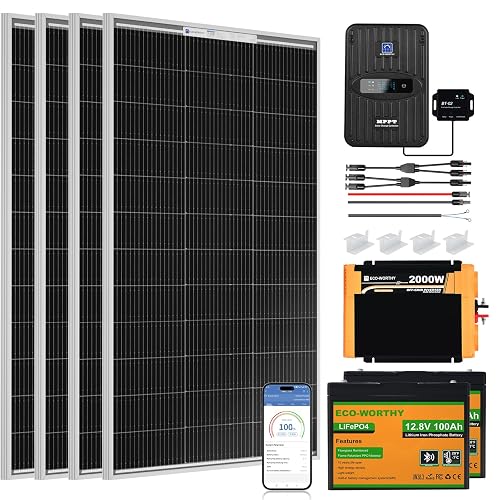 TOP CHOICEBest overallECO-WORTHY 1.6KWH Complete Solar Panel Kit 400W 12V for RV Off GridView on Amazon
- 2
 TOP CHOICEBest for small rigsECO-WORTHY 200 Watts 12V/24V Solar Panel Kit for RVView on Amazon
- 3
 TOP CHOICEBest budget pickECO-WORTHY 200 Watt 12V Complete Solar Panel Starter Kit for RV Off GridView on Amazon
- 4
 Best for weekend tripsECO-WORTHY 800W Off Grid Solar System Complete Kit for RVView on Amazon
- 5
 Best for heavier loadsECO-WORTHY 800W Solar Panel Kit with UPS Inverter Charger for RVView on Amazon
- 6
 Best for full-time boondocking92KWH Complete Solar Panel Kit for RV Off Grid Solar SystemView on Amazon
Our Top Picks
Quick Comparison
| Product | Best for | Key feature |
|---|---|---|
| ECO-WORTHY 1.6KWH Complete Solar Panel Kit 400W 12V | Balanced all-around RV use | 4 x 100W panels with 40A MPPT controller and 2 x 100Ah lithium batteries |
| ECO-WORTHY 200 Watts 12V/24V Solar Panel Kit | Small rigs and light loads | High-efficiency monocrystalline panel with 30A PWM controller |
| ECO-WORTHY 200 Watt 12V Complete Solar Panel Starter Kit | Entry-level buyers | Includes 2 x 100W panels, 100Ah lithium battery and 1100W inverter |
| ECO-WORTHY 800W Off Grid Solar System Complete Kit | Weekend and short off-grid trips | N-type bifacial panels with 314Ah lithium battery and 2000W pure sine inverter |
| ECO-WORTHY 800W Solar Panel Kit with UPS Inverter Charger | Running higher-draw appliances | 3000W UPS inverter charger and 60A MPPT controller with Bluetooth |
| 1.92KWH Complete Solar Panel Kit for RV Off Grid | Extended boondocking | Two 100Ah 12.8V batteries (2560Wh) with 4 x 120W rigid panels |
ECO-WORTHY 1.6KWH Complete Solar Panel Kit 400W 12V for RV Off Grid
4 * 100W Solar Panel + 40A MPPT Controller + 2 * 12V 100Ah Lithium Battery + Upgraded 2000W Power Inverter + Bluetooth Module ECO-WORTHY 1.6KWH Complete Solar Panel Kit 400W 12V for RV Off Grid
Best for: Balanced all-around RV use with moderate daily loads
This kit suits owners who want enough storage for a fridge, lights, water pump and device charging without moving up to a large custom build. It offers a meaningful step up in capacity from starter kits while staying manageable to install.
Key specs
- 4 x 100W solar panels (400W total)
- 40A MPPT charge controller
- 2 x 12V 100Ah lithium batteries (about 1.6kWh)
- 2000W power inverter with Bluetooth module
Pros
- MPPT controller generally harvests more energy than PWM in variable light
- Lithium batteries are lighter and tolerate partial charging better than lead-acid
- Bluetooth monitoring lets you check battery state from your phone
Cons
- Four panels need a reasonably flat, unshaded roof area
- The 40A controller can limit output on the largest panel arrays
Bottom line: A strong fit for owners who want a well-rounded system for regular weekend and week-long trips.
ECO-WORTHY 200 Watts 12V/24V Solar Panel Kit for RV
ECO-WORTHY 200 Watts 12 Volt/24 Volt Solar Panel Kit with High Efficiency Monocrystalline Solar Panel and 30A PWM Charge Controller for RV, Camper, Vehicle, Caravan and Other Off Grid Applications
Best for: Small rigs and light loads
Ideal for campers, small travel trailers and vans that mainly need to keep a few lights, a phone and a small fan running. It is also a sensible first step for people testing how much solar they actually use.
Key specs
- 200W total output with monocrystalline panel
- Supports 12V and 24V systems
- 30A PWM charge controller
Pros
- Monocrystalline panels are widely regarded as efficient for their size
- Supports both 12V and 24V configurations
- Simple layout that is easy to understand for newcomers
Cons
- PWM controllers typically waste more energy than MPPT on cloudy days
- Does not include a battery or inverter, so more purchases are needed
Bottom line: Best for owners with small power needs who already have a battery or plan to add one.
ECO-WORTHY 200 Watt 12V Complete Solar Panel Starter Kit for RV Off Grid
with Battery and Inverter: 2*100W Solar Panel + 30A Charge Controller + 100Ah Lithium Battery + 1100W Premium Solar Inverter ECO-WORTHY 200 Watt 12V Complete Solar Panel Starter Kit for RV Off Grid
Best for: Entry-level buyers who want everything in one box
A budget-friendly pick for first-time RV solar owners who want panels, a battery and an inverter included rather than sourcing each part separately. It works well for occasional camping and modest appliance use.
Key specs
- 2 x 100W solar panels (200W total)
- 30A charge controller
- 100Ah lithium battery
- 1100W power inverter
Pros
- Complete starter package reduces compatibility guesswork
- Lithium battery provides usable capacity without heavy weight
- Good match for light appliances like a small fridge or laptop
Cons
- A 1100W inverter may struggle with high-start-current appliances such as microwaves
- Output is modest for full-time living
Bottom line: A sensible starting point for weekend campers who want a complete kit without a large investment in parts.
ECO-WORTHY 800W Off Grid Solar System Complete Kit for RV
4PCS N-Type Bifacial 195W Solar Panel+12.8V 314Ah Lithium Battery+60A MPPT Charge Controller+2000W Pure Sine Wave Inverter ECO-WORTHY 800W Off Grid Solar System Complete Kit for RV Off Grid
Best for: Weekend and short off-grid trips with moderate power use
Suits RV owners who expect to be off the grid for a few days at a time and want a larger battery bank with a capable inverter. The bifacial panels also appeal to those parking in open, reflective spots.
Key specs
- 4 x 195W N-type bifacial solar panels (about 800W total)
- 60A MPPT charge controller
- 12.8V 314Ah lithium battery
- 2000W pure sine wave inverter
Pros
- Pure sine wave output is generally safer for sensitive electronics
- Large battery capacity supports longer stretches without sun
- N-type panels are often described as having good low-light performance
Cons
- Large battery and panels add significant weight that must be planned for
- Bifacial gain depends on a reflective surface beneath the panels
Bottom line: A good match for owners who want a substantial battery bank for regular short stays off the grid.
ECO-WORTHY 800W Solar Panel Kit with UPS Inverter Charger for RV
4PCS 195W Solar Panels, 3000W UPS Inverter Charger, 2PCS 12.8V 280AH Lithium Batteries, 60A MPPT Controller Bluetooth ECO-WORTHY 7.168KWH 800W Solar Panel Kit for RV Off Grid Complete System
Best for: Running higher-draw appliances and keeping power flowing during grid hookups
Useful for RVs with air conditioners or induction cooktops where inverter capacity matters, and for owners who want a UPS-style inverter charger that can also top up batteries from shore power.
Key specs
- 4 x 195W solar panels (about 800W total)
- 3000W UPS inverter charger
- 60A MPPT controller with Bluetooth
- 2 x 12.8V 280Ah lithium batteries (about 7.2kWh listed)
Pros
- Larger inverter headroom for heavier appliances
- Inverter charger function can help when plugged into shore power
- Bluetooth monitoring of charge and load
Cons
- Full capacity claims on listings should be checked against your own load profile
- Heavier and more complex wiring than smaller kits
Bottom line: Best for owners who run power-hungry appliances and want inverter capacity to match.
1.92KWH Complete Solar Panel Kit for RV Off Grid Solar System
1.92KWH Complete Solar Panel Kit for RV Off Grid Solar System |2x100Ah 12.8V Batteries 2560WH| 4x120W Mono Rigid Solar Panels |2000W Power Inverter|MPPT Controller|Trailer, Camper, Marine
Best for: Extended boondocking with rigid, roof-mounted panels
Designed for owners who plan longer stretches away from hookups and want rigid mono panels mounted on the roof. The dual 100Ah battery layout offers redundancy and flexibility in expanding later.
Key specs
- 4 x 120W mono rigid solar panels
- 2 x 12.8V 100Ah batteries (2560Wh listed)
- 2000W power inverter
- MPPT charge controller
Pros
- Rigid panels are generally more durable than flexible models
- Two batteries allow easier capacity expansion and partial redundancy
- Listed for trailers, campers and marine use
Cons
- Rigid panels require careful roof mounting and weight planning
- Installation is more involved than plug-and-play starter sets
Bottom line: Best for owners ready to commit to a permanent roof installation for long off-grid trips.
Buying Guide
Total system capacity and daily energy use
Start by listing the appliances you run and roughly how many hours each runs per day. Multiply watts by hours to estimate watt-hours, then add a margin of about 20 percent. Compare that figure with the kit’s battery capacity and the panels’ daily harvest, which depends on sun hours and season.
Good picks for this: ECO-WORTHY 1.6KWH Complete Solar Panel Kit 400W 12V, 1.92KWH Complete Solar Panel Kit for RV Off Grid
Charge controller type: MPPT vs PWM
MPPT controllers adjust voltage to extract more power from panels, especially in cool or partly cloudy weather. PWM controllers are simpler and less expensive but generally less efficient. For larger arrays, MPPT is usually the better choice.
Good picks for this: ECO-WORTHY 1.6KWH Complete Solar Panel Kit 400W 12V, ECO-WORTHY 200 Watts 12V/24V Solar Panel Kit for RV
Battery chemistry and size
Lithium iron phosphate batteries are lighter, handle deeper discharge and last longer than lead-acid. Check the usable capacity, not just the nominal rating, and confirm that the battery voltage matches the rest of the system.
Good picks for this: ECO-WORTHY 800W Off Grid Solar System Complete Kit for RV, ECO-WORTHY 200 Watt 12V Complete Solar Panel Starter Kit for RV Off Grid
Inverter size and waveform
The inverter must handle the sum of appliances that might run together, plus surge current when motors start. Pure sine wave output is generally recommended for electronics, compressors and microwaves. Check continuous and surge ratings on the spec sheet.
Good picks for this: ECO-WORTHY 800W Solar Panel Kit with UPS Inverter Charger for RV, ECO-WORTHY 800W Off Grid Solar System Complete Kit for RV
Panel type and mounting
Monocrystalline panels typically offer higher efficiency per square foot, while flexible panels are lighter but often less durable. Rigid panels suit permanent roof mounts. Measure your usable roof area and check clearance for vents, the AC unit and roof racks before buying.
Good picks for this: 1.92KWH Complete Solar Panel Kit for RV Off Grid, ECO-WORTHY 200 Watts 12V/24V Solar Panel Kit for RV
Weight and roof load
Panels, batteries and mounting rails add weight that affects handling, fuel economy and roof capacity. Check your RV’s manufacturer-stated roof load limit and consider placing heavy batteries low and centered inside the vehicle.
Good picks for this: ECO-WORTHY 200 Watt 12V Complete Solar Panel Starter Kit for RV Off Grid, ECO-WORTHY 1.6KWH Complete Solar Panel Kit 400W 12V
Monitoring, care and warranty
Bluetooth or display monitoring helps you track state of charge and avoid draining batteries. Keep panels clean, check wiring connections periodically and store lithium batteries within the temperature range listed by the manufacturer. Read warranty terms carefully before purchase.
Good picks for this: ECO-WORTHY 1.6KWH Complete Solar Panel Kit 400W 12V, ECO-WORTHY 800W Solar Panel Kit with UPS Inverter Charger for RV
FAQ
How many watts of solar do I need for an RV?
It depends on daily energy use. A small camper running lights and a fan may manage with 200 to 400 watts, while an RV with a fridge, water pump and electronics often benefits from 400 watts or more. Calculate your daily watt-hours first and divide by realistic sun hours to estimate panel size.
Can I run an air conditioner on a solar panel system RV kit?
Most of these kits are better suited to lights, electronics, fans and small fridges. Air conditioners draw high surge current and substantial continuous power, so they usually require a much larger battery bank and inverter than the kits here provide.
Do I need an inverter with a solar panel system for RV use?
You need an inverter if you plan to run standard 120V household appliances. If you only use 12V devices, such as LED lights and 12V fans, you may not need one. Kits that include an inverter save time on compatibility checks.
Is MPPT always better than PWM?
MPPT controllers are generally more efficient, especially with higher-voltage panel arrays and variable weather. PWM can still be adequate for small, simple systems where cost and simplicity are the priority.
Can I install a solar panel system on my RV myself?
Many owners do this successfully with basic electrical and tool skills, but roof penetrations, wiring and battery placement carry real risks. If you are unsure, consult a qualified RV technician or electrician, especially for lithium battery installations.
How long do RV solar panels last?
Solar panels are typically rated for many years of service, and manufacturers usually publish performance warranties. Actual lifespan depends on mounting quality, exposure and maintenance. Check the specific warranty for each product before buying.
Conclusion
For most RV owners, a solar panel system RV kit in the 400W to 800W range offers a practical balance of capacity and manageability. The ECO-WORTHY 1.6KWH kit suits balanced everyday use, while the 200W starter kits fit small rigs and first-time buyers. Owners planning longer boondocking stays should look at the 1.92KWH rigid-panel kit, and those running heavier appliances should prioritize the inverter capacity of the 800W UPS-style kit. Match the system to your real daily energy use before choosing.
Sources
- Background on how solar photovoltaic systems work and the factors that affect output (energy.gov)
- Research on solar resource data and system performance modeling (nrel.gov)
- Electrical safety standards relevant to battery and inverter installations (nfpa.org)
Related reading
- Top 6 RV Solar Power System Picks for Every Need (2026)
- Solar Panels RV Installation: 5 Best Mounting Kits and Panels (2026)
- Renogy RV Solar Panels: How to Choose and Install the Right Kit
About Claire Whitaker
Claire Whitaker is part of our editorial team and reviews and edits our small-scale solar guides, checking product details against manufacturer specifications and owner feedback.